With as complex as English can get with tenses to describe when things happened or will happen, I start to wonder if English-speaking cultures value or respect people’s time more than other cultures. Comparing American and Japanese culture, it certainly seems that way. “Time is money” vs. Japanese culture’s total disregard for people’s time.
5 Likes
While you are probably right, I do think the way counting and numbers are done1 in Chinese are a large part of why they tend to rock at maths. Might be true for Hindi as well?
1) Very, very regularly and logically. One, two, etc. One-ten, one-ten-one, one-ten-two, etc. Nine-hundred-four-ten-eight, 948. Compare that to four-twenty-eighteen for 98 in French.
2 Likes
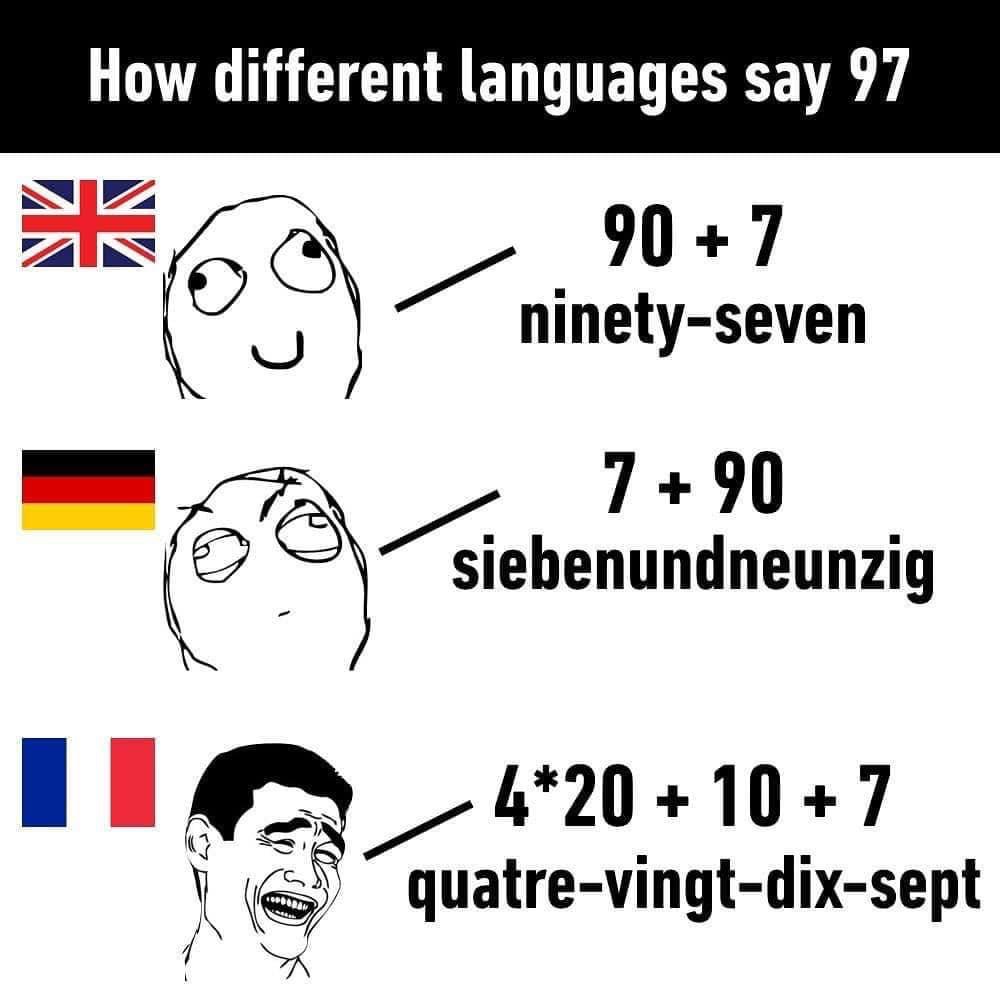
Japanese would be 9*10+7. Once you get to the 100,000 range and up it gets weird though, because they operate in 10,000s instead of 1,000s like English. Comma placment isn’t as important, since they look for the number of zeroes instead. Which wreaks havoc on my spatial-relation-focused brain. I can’t tell the difference between 5 zeroes and 6 zeroes without taking a full three seconds to count them, but I can identify the location of a comma within milliseconds.
6 Likes
In Chinese, because basic words are monosyllabic, with tone making one syllable carry multiple meanings as well, there’s a lot of interplay of meaning within words and expressions. The sound of the words for ‘four’, ‘ten’ and ‘death’ sound pretty much alike. So of course, 4 is an unlucky number, and 44 doubly so! ‘eight’ on the other hand sounds like ‘luck’ so that’s the number everyone wants.
Within written Chinese, not only do they play with how different word sound alike, but also with how they can look alike. Chinese poetry is therefore often utterly untranslatable.
6 Likes
OMFG, the way this is just perfect…
I CACKLED! 

6 Likes
Exactly! I still struggle with that today.
Belgians invented their own way: septant (70) and nonant (90) 
3 Likes
It’s an old remnant of the base-20 system, which was very common around the world and even in North West Europe before the Romans came.
The Danes still use it for the tenfolds from 50 to 90. Between for example 50 (which they call something like two-and-a-half-twy) and 60 (thir-twy), they do count ten digits.
Check more examples here:
3 Likes
Just one fluent language. Texan. Limited abilities in Spanish and US English.
6 Likes
Oh, I should have listed that. I’m also fluent in “Beef grilling and guttoral sounds” having lived in El Paso and Houston.
1 Like
As @Clutch states, Japanese often skips the subject as it hopefully is conveyed by mutual understanding. So you’d think that all this syllable-skipping would equate to fast communication. But no. Among the world’s top 10 most spoken languages, Japanese is last for units of information conveyed over units of time.
5 Likes
Just like their productivity per working hours 
4 Likes
English native, but after dealing with certain members of the great british public, think I am now completely fluent in idiot
And also a smattering of German from school but that was many years ago and listening to rammstein 
6 Likes
… und ich hab’ nichts gesagt!
3 Likes
Alles Nichtskönner, originale Nichtskönner! Wie die Norweger. Deswegen sind die auch nicht in der EU weil die am Leben vorbei laufen
4 Likes
But they have high life expectancy, so perhaps there’s some sense in that.
2 Likes
Combination of more natural foods (though lacking in some nutrients and quite carb-heavy), more public transport, and yearly mandatory physicals at the workplace, really. Though I don’t put much stock in life expectancy calculations because they don’t account for abnormalities that skew the statistics.
1 Like
So do the French and they eat lots of fat, drink gallons of wine & smoke god-awful cigarettes.
3 Likes
Enter the Italians, with grease stained tank tops and fat bellies full of carbs.
3 Likes
Which is why I don’t buy into the whole keto/low-carb hype.
5 Likes
Ok, they also work 2h less per week than most other European countries.
2 Likes