To find the latest polar orbits just bring up the ‘Satellite Catalog’ option, and sort INTL DES until you get ‘UNKNOWN’ (that’ll be the latest) and then you can hit + to add then and see their paths etc. Either that or search by the ID in my screenshot above.
Obviously that line of the few polar inclination ones they have so far will spread out a bit, plus they’ll going to need a lot more. To animate it all, drag the ‘time wheel’ on the bottom left to speed up time (above the 1x0).
The TL;DR is it’s a 150 Mbps down / 16.5 Mbps up, 20ms latency that’s a $600 initial outlay for a pizza-sized box that goes on a roof and then $100 a month for unlimited data. If you live somewhere rural and get a worse deal than that then maybe worth a look.
How does that compare to regular DSL/Cable prices in the US? Over here it would be a bit more than double what you pay over landline, which seems fair for remote locations.
Usually in the US if you sign up for a subscription you don’t have to pay for installation, though you are in a 24 month contract. Monthly pricing for just internet is usually between $40-$100 depending on the provider, service type, and speed. If you’re bundling cable TV you can easily clear $200 a month. I haven’t shopped for service in a while, I am lucky enough to have Google Fiber. $80 a month unlimited gigabit speed, and all hardware included, no install charge. They had another plan which was a single time $200 fee to install the fiberjack and provide a modem. IIRC 200 mb/s speed and no additional charges ever.
This thing is meant to compete with existing rural ADSL or Sat link. Something like HughesNet Internet costs about $150.00 per month, depending on how much data your package includes. All plans include the same speed—up to 25 Mbps download and 3 Mbps upload. That’s with 800-900ms latency.
It’s not really for those in built-up towns on fibre already, or even those in suburbs on DSL. Potentially it can get up to about 1Gbps but unlikely for a while.
Ha! Well my reviews really are not much more detailed than ‘I like it!’ or not.
As for Starlink, apart from the initial equipment purchase, the expense is about the same as what I am currently paying for a WISP connection that gives me 25Mbps down and 5 Mbps up (on a good day). My ISP is sending a technician out next week to aim my dish at a closer tower. I’ll be asking him what the company is planning to do to compete with Starlink. I’m hoping that there will be some kind of co-operation between Starlink and the current rural ISP’s. I’d like to have the equipment professionally installed and maintained for example. I’d gladly pay a maintenance subscription on top of the connection if it was reasonable.
Not sure if useful, but I think their phone app lets you do stuff like ‘check for obstructions’ from where you live and the install steps. Kinda neat ‘self service’ way to do it.
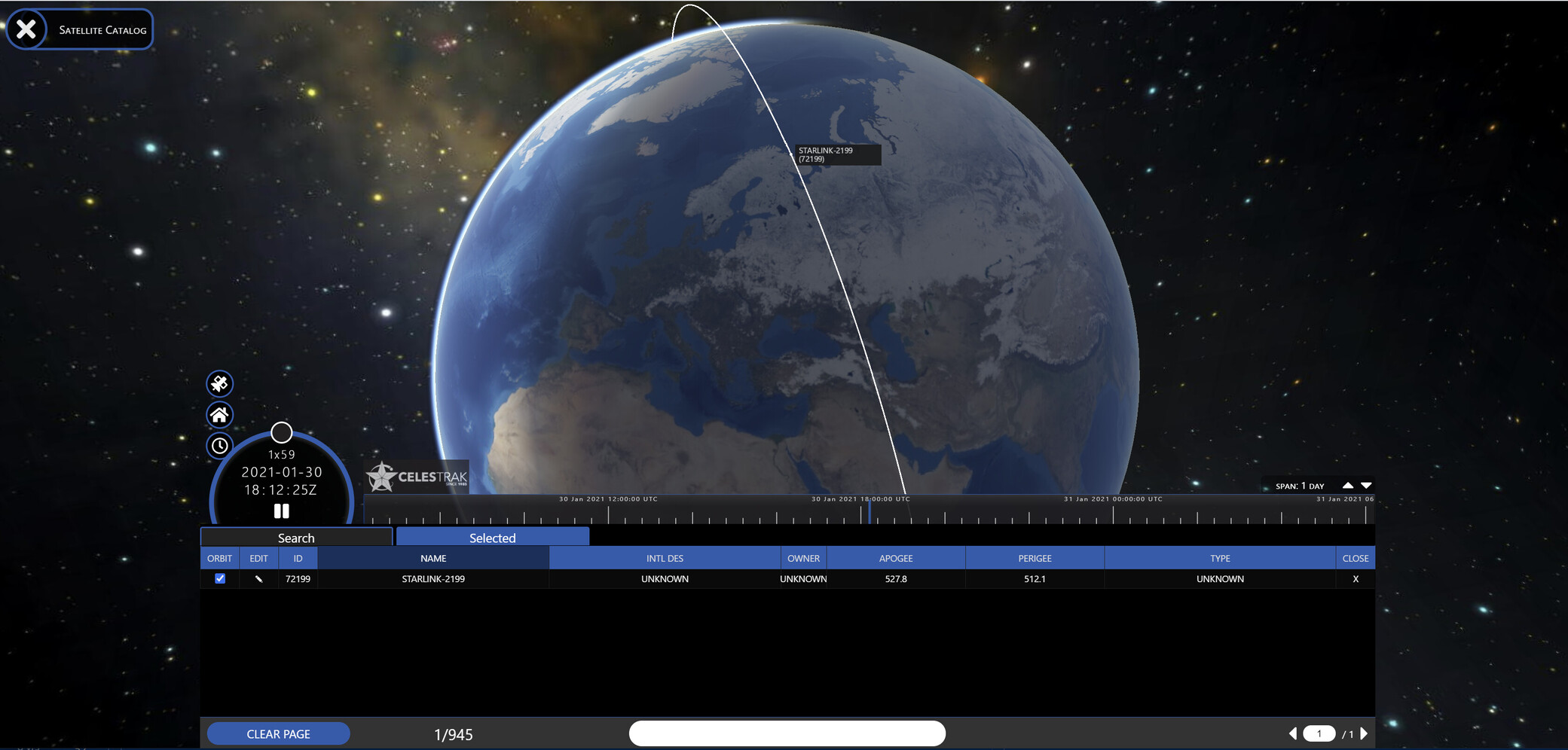
 option, and sort INTL DES until you get ‘UNKNOWN’ (that’ll be the latest) and then you can hit + to add then and see their paths etc. Either that or search by the ID in my screenshot above.