The way I read it was corrosion leading to stuck vanes…or?
Anyway, staggered engines or not, still a bit unlucky for it to affect both engines on the same flight. Makes me wonder if there were some special conditions that exaggerated the issue, that day…? The final report should be out soon.
Not stuck as such, harder to move into the correct position and not always reaching the minimum required positions under certain loads. so, semi-stuck? Anyway, it’s quite fascinating and only a look at the actual engines so yeah the full report hopefully has answers.
I’ve had two in-flight jet engine failures, both Airbus’s with V2500s. One was a FADEC failure (engine relit in one second). The other was on rollout after a VSV fault (ECAM warned that this would happen). I’ve had two VSV failures come to think about it.
Yeah technically both are FADEC failures because the VBV/VSV system is a inherent part of FADEC together with the EEC and some other bits and bobs. Well for GE it is, though definitions can be muddy from mfg to mfg.
I think, if my 30 yo memory serves, that in the case of the IAE 2500, the VSV fault was usually a hard fault in the actuator itself. The engine (FADEC?) would command the vanes to a position but they would fail to move for whatever reason. The engine would then quit at low-speed idle due to insufficient airflow. But I am only a redneck amateur mechanic and am likely totally mistaken. Also, despite the faults we experienced, I liked the engine, especially the later A5 variant. Powerful, efficient and simple.
FADEC is usually used to describe the whole system, the EEC is usually the brains that(big grey box on the side of a fancase) that commands the actuators to move to a position. These are fuel driven actuators via the HMU which also can be a failure point of the system for example.
I was lucky enough to have the start of a dual engine flameout descending into PGV (Pitt-Greenville, NC). I was in the right seat as the PIC the SIC was flying. We were given a descent out of some altitude (had to have been around 6,000 or so because we were pretty close to the airport. The SIC flying retarded the engines (Citation - JT15D-5D) and after a few seconds I noticed both low oil pressure lights (both red) illuminate on the warning panel followed by the flashing red master warning. I said simply “both engines are failing”… I told the SIC to push the throttles forward…the engines relit. Thankfully. Or we would have ended up in a swamp or field or something. We climbed back up to an enroute altitude back to Charlotte, and briefed we would use full gear/flaps/speedbrakes all the way down final and split the engines so that one would be delivering higher than normal power. And accept a slightly faster landing speed.
The cause, as described to me, was the installation of I think an exciter box on BOTH engines upside down that caused some kind of interference with the throttle cable. I was told this…but I don’t know if it was the truth. Whatever the case…the low-idle stop was reached and exceeded at the low idle position of the throttles, resulting in them going into fuel cutoff. Our chief of maintenance was let go shortly thereafter for personal reasons that were affecting his work.
I’ll be very curious to read more about the mechanical failure in the Hop-A-Jet plane. It seems awfully coincidental that they failed in exactly the same manner at exactly the same time.
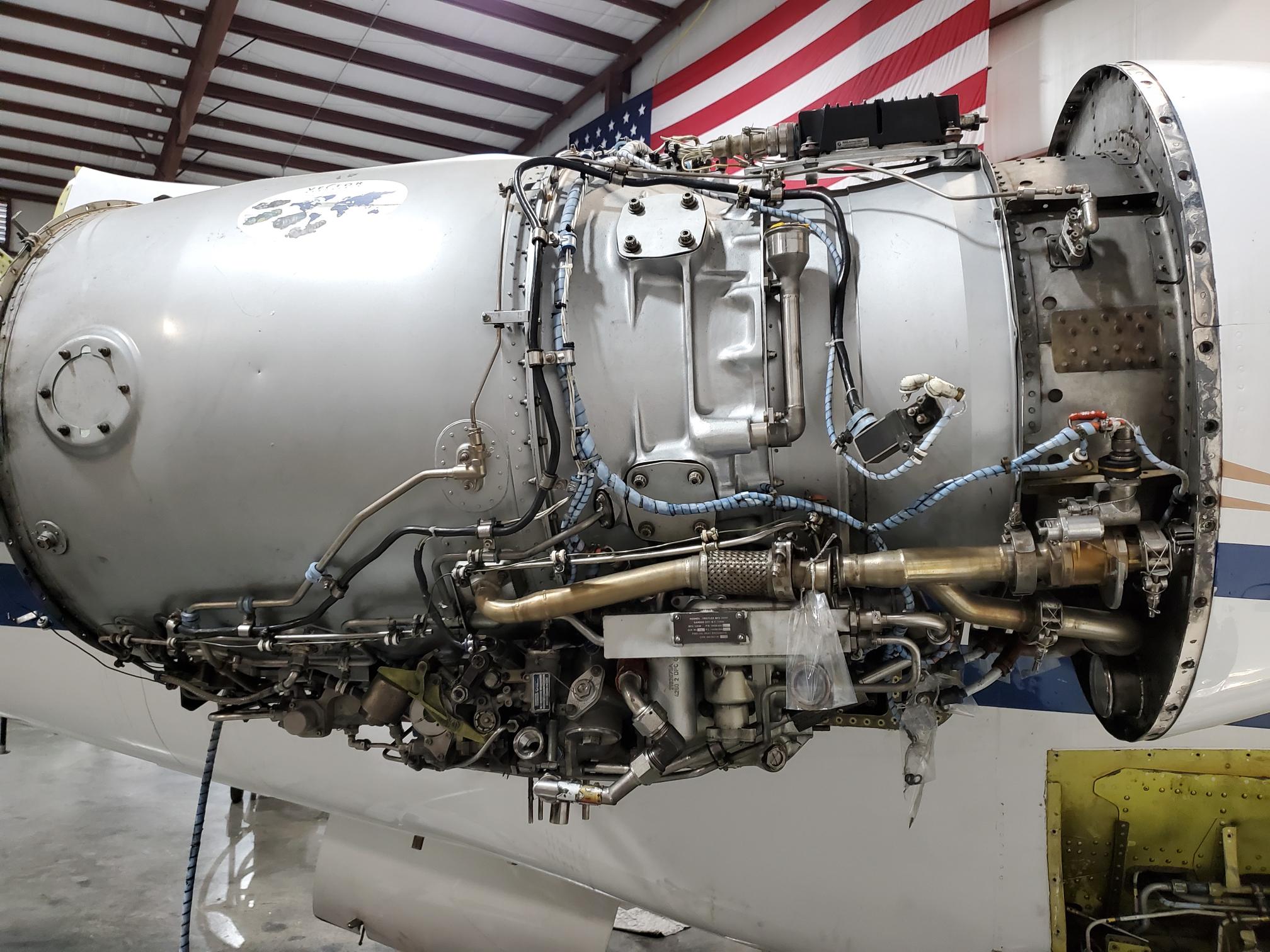
I have no idea what I’m looking at here…but the exciter box maybe is that thingy with the two plug looking caps on it?
Not quite sure, on the top looks like it could be a ECU based on the cooling fins, on the bottom it looks like some sort of HMU. The Exciter box usually is small with two thick leads going into the engines combustor, these are the ignition leads that go to the igniters(Create a spark for the engine).
On GE engines i don’t think you can even install them upside down these days.
Honestly this engine looks a little alien to me, more like a APU with missing bits, I am not seeing any fuel nozzles or a manifold for the fuel either. It sure is a design that I am unfamiliar with.
EDIT: Searching around a bit I think the Exciter box is on the otherside of this engine.
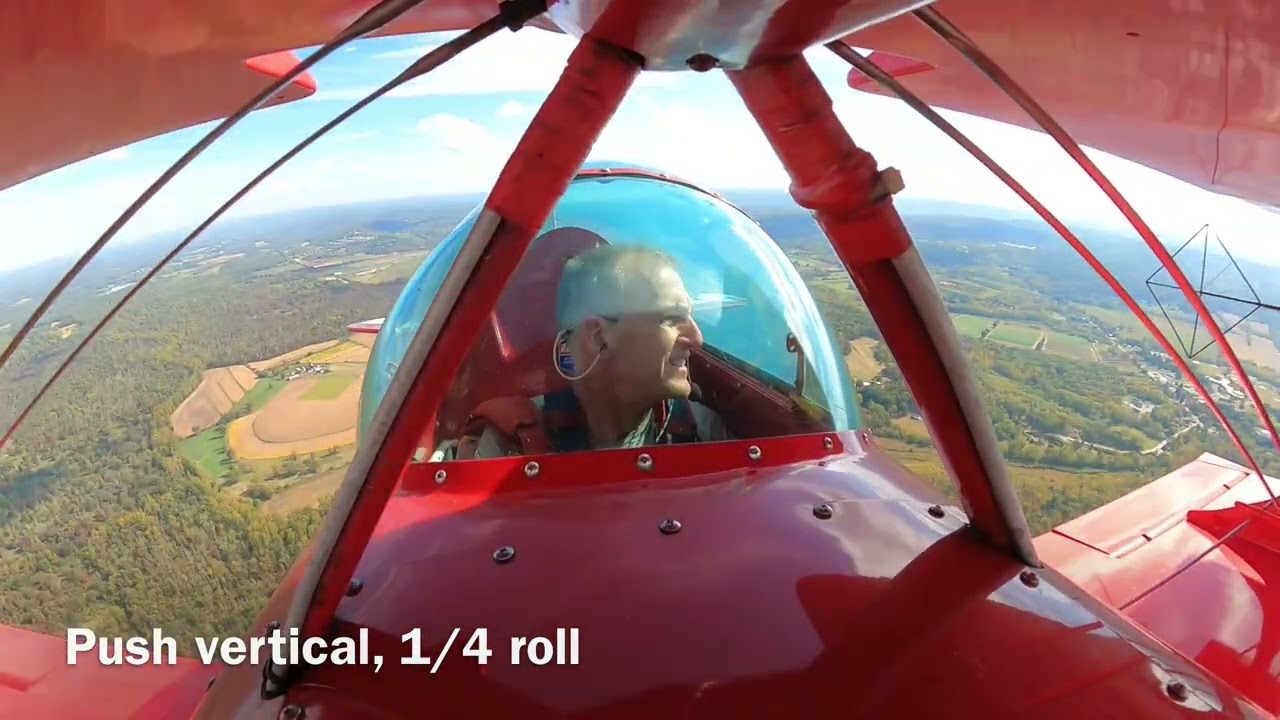
And I’d be interested to know: what’s the max G (plus and minus) of those maneuvers that you flew there? I know next to nothing about aerobatics so your videos are always fascinating for me.
Great to see the control surfaces deflect!
Is there a way you could rig a camera so one could see all control surfaces? Maybe on the upper wing, looking back? Don’t need to see the lower wing ailerons. Would be really cool to see how you work the controls, simultaneously…
Oh, and I’m contemplating changing your username to The Red Captain, or something similar…
If the canopy wasn’t in the way, we’d be able to see everything. Or maybe I could move the camera back. The cockpit is unbelievably small. I’ve had a gopro mounted inside before but had to keep my head tilted awkwardly to one side. I’ll see what I can do, maybe using a sticky mount. I too could benefit from seeing the inputs. The snaps especially vary wildly in rate and appearnace with very small timing changes. Nearly 15 years of doing them and they still mystify me.
In that sequence I pulled 6.3 and pushed 3.2. That challenge for keeping the negative g’s down is the push 1/2 loop. If I had more power I could probably do it in 2.5. But as things are with my lowly 180HP, I would be too slow at the top of such a big loop. So instead I have to push a little harder. That’s what happened with the Humpty. A crosswind was blowing me out of the box. After I pushed straight down and quarter-rolled, I figured I could make a big, slow-pull loop up and get some box back. But after the 3/4 roll I torqued badly off the top. That’s what’s cool about being confined to a 1000m cube, energy management is everything.
Also, sadly, this was the last sequence designed by the late great Rob Holland.
PS, I bought a pair of the new Meta-Raybans strictly so that I could record mu control inputs. But they flop all over my head and the camera is angled such that the inputs are outside the field of view.