DCS F/A-18C

A similar story…confirmed true …it happened to me.

When I was the SIO (Ship’s Intel Officer) on USS GUAM we were steaming in the VACAPES (Virginia Capes OPAREAs). We had nothing to do one day, no Marines or helos onboard, and were just slowly steaming around. WX wasn’t hte greatest, overcast and windy but no rain, so I decided run laps on the empty flight deck.

About 10 minutes after I started running I noticed that the wind had really started to pick up. At first it wasn’t too bad…it had been a fairly strong head wind when I had started…but now it seemed to get stronger each time I ran towards the bow. It was getting ridiculous.

Running towards the bow I felt like I was leaning forward at a 45 deg angle…I was running about as hard as I could but with each step I was making little progress. Running back towards the stern, with the wind behind me, I was like a gazelle, leaping more than running…I had to watch my footing as I got near the stern so I didn’t fly overboard.

I had planned to run for a half hour but after 20 minutes I looked at my watch undecided it was enough. I did one more lap and headed back into the ship.

Later, one of my fellow officers came up to me grinning and told me what had happened. He had been on bridge watch during my run. The CO was on the bridge. Everybody was bored out of their minds…slowly doing Ahead 1/3 on a gray VACAPES day…

Then the Skipper sees me running. He glances up at the wind speed indicator which was showing something like 20 knots down the deck. He directs “All Ahead 2/3” and watches the wind pick up…and watches me attempt to battle it. About every other of my laps he orders another speed increase, Ahead Full and then Ahead Flank. GUAM was not a fast ship and at Flank speed did about 21 knots…but 21 + 20 = 41 knots over the deck.

By now the whole bridge crew is watching me. They broke out in laughter when I looked at my watch. After I left the flight deck, all the fun was over and the CO order them back to Ahead 1/3.

Later that day the Skipper saw me in a passageway and asked,“How was your run today.” I replied that it had been “a bit windy”. He grinned and offered something like, “I bet it was”, and walked away chuckling.

14 Likes

Release dates announced.

Persian Gulf: 23 May
F/A-18C: 30 May

6 Likes

Home and off duty on the Hornet release, at least… :slight_smile:

1 Like

That’s a lot of math…naval aviators don’t like doing math. I think the classified NATOPS has baseline combat radius’ for different profiles and different standard load outs…a table kind of thing for Hi-Hi-Hi (never done), Hi-Hi-Lo, Lo-Hi-Lo, Hi-Lo-Hi, Hi-Lo-Lo and Lo-Lo-Lo.
(Can’t remember exactly what the three phases are…something like en route, ingress/egress, return.

However, combat radius is often a secondary consideration since typically, one launches, then hits a tanker before going on the mission…and maybe hits a tanker on their return.

The secret to winning a modern air campaign–gaining air superiority and conducting strikes at will–is not the agility of the jets, the power of their radars and combat systems, nor the lethality of their weapons.

The secret to winning is simply “gas in the air”…enough tankers airborne to keep the fuel-guzzlng fighters/strike-fighters from flaming out. Not sexy or exciting…but that is the way it is.

Keeping things uncalssified, I saw a very important, high-profile mission almost fail due to tanking issues…it didn’t…but it was a close thing.

So, with that in mind, when DCS comes out with the FA-18E version I’ll be the “hero” and fly the tanker package. :sunglasses:

7 Likes

And this is why we need an Intruder.

4 Likes

At least we know now. gonna be a good summer for flight simming.

2 Likes

So what might a Hornet mission look like by the numbers?

Disclaimer - this is not a NATOPS approved, Hornet type-rated pilot, CENTCOM approved profile…I’m just a guy with a new airplane…so take it for what it’s worth…

I was curious what the fuel consumption and profile might look like for a kinda/sorta mission so this is what I came up with.

Al Dhafra takeoff to strike Lar ~ 204 nm trip there so around 508 nm round trip. No ingress/egress/rally waypoints, just a simple there and back…so keep that in mind.

Full internal fuel, 10 Mk-82 Snakeyes, 2 AIM-7, 2-AIM-9, no external tanks.

I took the liberty of a hot start on the ramp, so you might want to deduct another 4 or 500 lbs. of fuel from these totals for a more thorough start.

Takeoff Fuel = 10,700 lbs.

I used an afterburner takeoff until 200 knots, then selected 90% power for the rest of the flight. In afterburner at sea-level you are consuming 15,000 lbs. per side, but that is the limit of the gauge from what I read, so maybe it is more than that?

At 90% RPM I wagged a cruise climb number. Our Citations climb on a schedule of 250 knots to Mach .62 which we hold all the way up. For the Hornet, I just tried Mach .70.

At 10,000’ indicating 4,800 lbs. per hr. / side (9,600 lbs/hr total) at M.70 giving 2,000 FPM climb.
At 15,000’ indicating 4,100 lbs. per hr. / side (8,200 lbs/hr total) at M.70 giving 2,500 FPM climb.
At 20,000’ indicating 3,400 lbs. per hr. / side (6,800 lbs/hr total) at M.70 giving 1,500 FPM climb.
At 25,000’ indicating 3,100 lbs. per hr. / side (6,200 lbs/hr total) at M.70 giving 1,300 FPM climb.

I wagged it and figured FL250 would be a fair altitude. Climb to FL250 was reached 80nm north of Al Dafra with 8,300 lbs. fuel remaining.

90% RPM at FL250 showed 3,500 lbs. per hr. / side (7,000 lbs./hr total) at M.85 / 342 KIAS / 518 KTAS

10nm from the target I had 6,890 lbs. of fuel remaining

Rapid descent to 10,000’, dropped all my bombs (even though they were high drag…I just wanted to get rid of them) then selected afterburner for 15 seconds to simulate sorta getting away from the target and back up to altitude. After 15 seconds, pulled it back to 90% for the remainder of the climb away from the target area and resumed the M.70 climb speed. After the AB and climb left with 6,600 lbs. of fuel remaining.

Up to FL250, maintaining M.70 in the climb at 90% power was netting 4,400 FPM due to the lack of ordnance and drag.

Back up at FL250 fuel flow 3,500 lbs. per hr / side (7,000 lbs/hr total) but now indicating M.88 for the return flight.

I had preset my BINGO at half the fuel level and reached half fuel with 109nm to go to Al Dhafra (so basically 75% of the distance has been flown already).

50nm from Al Dhafra, started a 3,000 FPM descent putting me at 8,000’ over the field with 3,920 lbs. fuel remaining.

Overhead pattern to landing - landing configuration on AOA and 130 knots uses 87% power at 4,500 lbs. per hr / side (9,000 lbs/hr total).

Landed with 3,670 lbs. of fuel

Total mission duration from takeoff to landing was 54 minutes.

Obviously, you could fly a bit higher and pull the power back and probably gain some fuel efficiency, but these aren’t high bypass turbofan engines, so they aren’t super efficient. Some poking around says they are .34 bypass engines whereas something like the planes I fly have .70 bypass. So I don’t know if going higher is going to help you out too much. @boomerang10 will come along shortly and correct all of my mistakes and inaccurate statements hopefully…

This mission had no real evasive stuff, was a HI-HI-HI profile, and there was no dogfighting or holding or anything else much. So obviously, if you are marshalling at a carrier or having to shoot an instrument approach or dodge missiles, your fuel margin is going to be way thinner. I purposely didn’t carry external tanks because I wanted to see what the internal fuel could do with regards to range.

This was all probably pretty useless…but thought someone might find it interesting.

4 Likes

I still think the most impressive logistics planning had to be the Black Buck missions during the Falklands War. I would have barfed if I saw this plan prior to stepping to the aircraft…

image

5 Likes

The carrier is typically the Guidon of the formation. The escorts are given a sector based on the Guidon - it’s all in degrees relative to the Guidon’s heading; between a set of ranges…a piece of pie where somebody has taken a bite out of the pointy end.

Exactly - the formation’s bridges/combats are all on the same freq…think its called Fleet PRITAC or something like it. When I was a midshipman on CG-28, PRITAC was “in the clear” (unencrypted) so all the course changes were sent from the Guidon (carrier) in a voice code that combat would decode and pass to the bridge i.e., “Bridge/Combat last over PRITAC–Formation heading 270 degrees, standby to execute”. A few minutes later, over PRITAC, would come the execute order.

Actually not really. When the escorts get the upcoming heading change over PRITAC, the bridge team plots a course that will get them where they need to be in the formation on the new heading. When the execute order comes over the radio, the Conning Officer gives the Helm and Lee Helm (engine order telegraph…or whatever they use on the modern CGs and DDGs) the new heading and speed. That said, you might want to keep the “Shotgun down the threat axis” (keep the close in CG between the carrier and a potential threat) which means it may have to move to the other side of the carrier…that kind thing would be pre-briefed.

4 Likes

EXACTLY! All those other aircraft just to get that one “blue line” to the target and back…the ultimate “gas in the air” evolution ever.

1 Like

Local throttle control on the bridge, if Main Control decides to let them have it.

Ah, this makes sense.

And gave me flashbacks to learning trick drill in the snow during boot camp.

For you amphibious types. When we get into a pattern at FL2000 what speed should we attain so we don’t drive up the backside of another craft in the holding pattern
@boomerang10 @Navynuke99

Actually, a very good exercise…are you sure you don’t want to join the Navy?:sunglasses:

Some important points you brought out:

  1. You started on the ramp, so a full bag of gas is OK. If you had started on the boat you would have had to consider your “Max Trap” weight…if you go off the pointy end of the ship and immediately suffer a “Land ASAP” failure, you don’t want to be spending too much time dumping fuel. So you probably launched with less than a full bag of gas…then headed to the tanker to top you off.

  2. FL250 is probably right - between there and FL300. I remember the Tomcats liked to stay around FL200 - balance fuel and maneuverability.

  3. 10K ft is the standard “keep me above the max altitude of small things that can shoot me down” altitude. however, one must remember that this is 10,000 AGL not MSL. i.e. if the bad guy with the MANPAD is standing on terrain that has an elevation of 2000 ft above sea level, your altitude would be 12,000 MSL. Hopefully your intel officer gave you that information before you took off…if I’m your intel officer, you will have been briefed. :sunglasses:

  4. Your mission took 54 minutes, which is fine because you were working out of an airfield. Flying off the boat, we use 90 minute “cycles”, so you would need about another 30 minutes flying circles before you could trap/land. Time to hit the tanker. :sunglasses:

  5. You got home (overhead) with 3,920 lbs of gas - again, great because you are landing at a runway. For carrier ops, you want to be “Max Trap on the Ball”…meaning your aircraft weight when you roll into the groove and at 3/4 mile “call the ball” should be the maximum weight allowable for a trap. Getting to this number involves how much ordnance you dropped, your configuration (tanks, pods, etc)…but you already figured all that out before you launched, so the only variable you have is your fuel load…pump or dump to get to that weight. Why max trap on the ball? If something goes wrong on the flight deck or you have wave offs, bolters, etc. :open_mouth: you need enough fuel for at least a couple more “looks at the deck” (attempts to land).
Again, a great planning exercise - you definitely covered all the bases! :smiley:

3 Likes

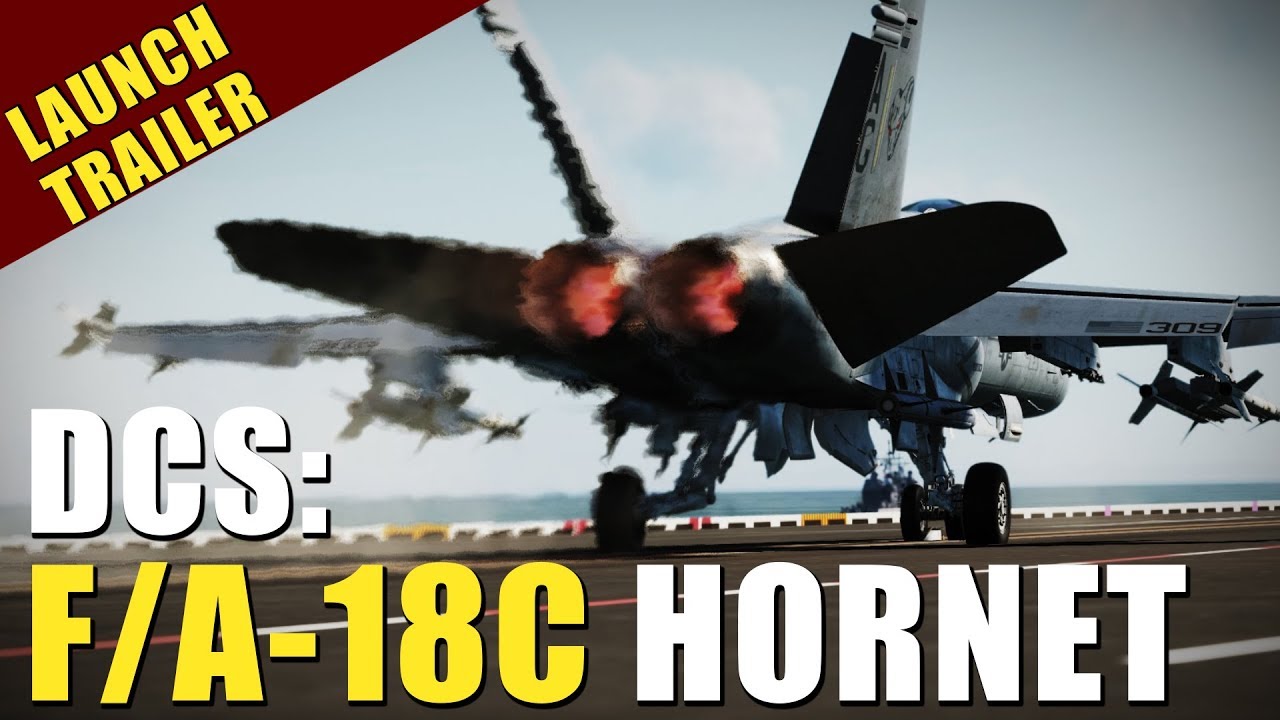
Official Hornet Release Update
"DCS: F/A-18C Hornet and Persian Gulf Map for DCS World Update
As we rapidly approach the release of the Hornet and Persian Gulf map this month, we are now pleased to announce the exact release dates. We will first release the Persian Gulf Map for DCS World on 23 May 2018 and then DCS: F/A-18C Hornet on 30 May 2018! We will release both this month as promised.

In order to meet your expectations for the Hornet early access release, we decided to move the Hornet release to shortly after the Persian Gulf Map release. Items we still need to complete are:
Completed radar-directed AA Gun, AIM-9, and AIM-7 symbology
AUTO bombing mode
Radar contacts on the Electronic Warfare (EW) Page
The Moving Map

We believe these are all vital for a great early access release.
Please also note that the Pre-Purchase discounts for the Hornet and Persian Gulf map will soon be ending with the release of the early access versions. Act now for a significant discount:
DCS: F/A-18C Hornet: $20 off now
Persian Gulf Map for DCS World: $10 off now

2 Likes

Holding patterns are separated by altitude. You and your wing man stay at the same altitude The other flights/sections from the airwing are assigned different altitudes.

Not always a day time thing since often you come into the break and land.

In bad WX and/or at night we use the “Marshall Stack”. It is a holding pattern at a set brg/rng from the CVN. Again, each flight/section is assigned an altitude and stay there until its time to land…the “push”. At that point, the section in the lowest level of the Marshall Stack takes their interval - distance between aircraft to achieve 1 minute (or is it 90 seconds at night… @Navynuke99?) separation and head towards the carrier using the Carrier ILS to direct them. When the lowest section has “pushed”, everybody drops down to the next level. “Wash-Rinse-Repeat” until everybody is back aboard.

3 Likes

No way we are going to mess this up on release day. Probably going to resemble a drunken session of the game Carrier Deck.

1 Like

Real men (and women) do this with the “Ouija Board” in Flight Deck Control…and with a heck of a lot more planes…just say’n…but trying this game drunk sounds like fun…is it multiplayer? :wink:

It’s single player only, and surprisingly fun. I’ve beaten every level. First “casual” game I’ve actually liked.

1 Like

I’ll send you a couple cases of Yuengling Black and Tan then see how you do. :wink: