Fun Fact: It is practically impossible to take off with engine anti-ice on. This can become an issue if you hot start a mission in a chilly environment (it does not have to be at/below 0ºC). It will have engine anti-ice already set. So you need to turn it off until the Hip gets airborne and flying forward.
1 Like
Thanks Will for the informative posts, by the way! We’re all benefitting from your “deep dive” into the Magnificent Eight!
I agree about the offensive capability: after a bit of practice, my impression is that the Hip is a better weapons platform than I initially thought.
Just like in the Huey, how well or badly an attack run will go is pretty much 100% a result of the initial set up: if you have to trim, play with the pedals or hold tension on the joystick during the last 5 seconds before firing, accuracy is going to suffer.
After the final trim, just before firing, my method is to zoom in with a relaxed joystick hand and wait for the target to get to just above the crosshairs, then walk the burst over them with minimal correction. I don’t wait to confirm effect - as soon as I release the trigger, I press and hold the trimmer and try to set up a smooth but strong break turn pull off the target.
None of the guns have the reach or accuracy of the A-10 monster gun, of course, so you have to account for the drop during flight and a reasonably large shot grouping size…but the rotary guns aren’t too bad for it, I’m starting to get a feel for the 12.7mm’s.
They are not stand off weapons: your break away circle will be well within AAA and even small arms range…but that’s just a case of “get used to it comrade”. As always with the non-computerised sights, there are no free lunches - your firing slant range vs. your break away distance are a compromise between the guns’ lethality and your survivability.
This, together with Will’s comment regarding anti-ice, leads me to my next comment / observation:
Generators? What generators?
I tested out the Instant Action mission, I think it’s called the “Convoy Attack”. The scenario is set in winter and takes place at altitude (I forget the altitude, but definitely well above sea level).
I started out setting up my rocket runs properly, but soon got impatient and barged in for a run after a hard break turn without really setting up the parameters, trim, speed and so on.
What happened next was interesting.
I pulled out of my rocket dive and the helicopter pitched up a lot more than I intended, a good 30-40 degrees pitch, I think.
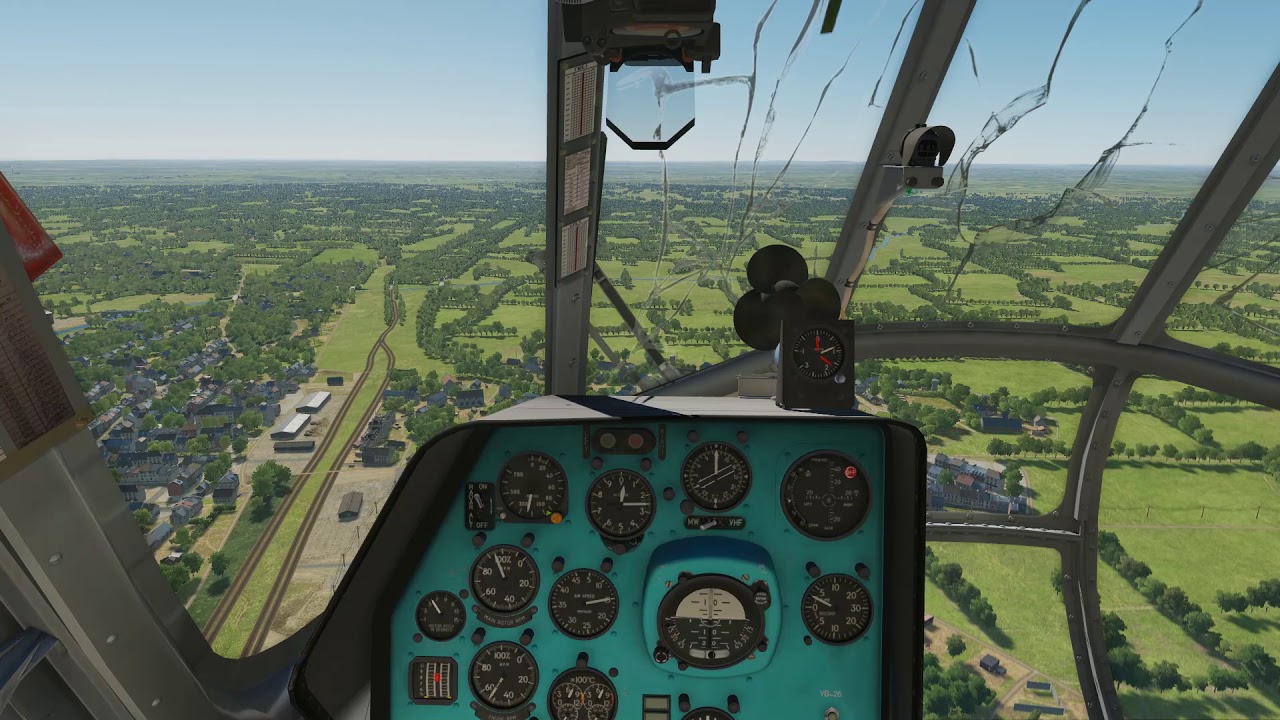
As a result of the sudden pitch up (to which I instinctively responded with a collective increase as the speed dropped), the rotor RPM dropped into the 80% range and kicked out the generators as well as the P/R autopilot. I was taking .50 cal fire during the run.
I fought the helicopter back under my control, trimmed her and limped away out of LOS with the rotor RPM staying at 80% and the generators off.
Once out of harms way, I set up for level flight and tried to assess what was going on. Both generators were out, RPM was at 80%, but fuel, hydro etc. were ok and the critical instruments were working without the generators.
I was stepping on the ball hard to keep the helicopter in coordinated flight, but I think that was affecting the RPM further, because when I instead let go of the ball and compensated with cyclic, I gained some RPM – but not enough for the generators.
I could not assess whether I had flight surfaces damage, because I had had such limited experience of flying without the P/R autopilot…so I don’t know whether the pedal requirement was caused by wind, damage or something else.
I also had anti ice on, which would not have helped with the RPMs, but I didn’t have the presence of mind at the time to turn it off.
I fired up the APU and the standby generator, but those didn’t seem to help in turning on any of the instrumentation and I still couldn’t turn on the AP.
I believe I could have flown the 35NM to the nearest airport, but it was late so I set down on a road next to a village after a little while.
When I set down, and lowered the collective all the way, the RPM’s came back to 95%. I turned the generators back on successfully and was able to turn the AP on also. Maybe it was damage to the engines, maybe it was high altitude, icing, just poor flying…I don’t know why that RPM stayed so low for the rest of my flight. Now I’m thinking that maybe I lost an engine…but I thought I did look at the T’s and P’s etc. on both engines and don’t recall anything.
So, while this is a poor learning scenario in the sense that I have no idea what really happened, I think the learning is – with this bird it’s going to pay well to learn the inner workings of the systems. It pays to know your cockpit flows, too…my head was turning like a crazy person and all the switches suddenly looked the same.
That generator mechanic (generators turn off at 88% rotor RPM) is really important to understand, as it’s going to get you right at the time when you’re task saturated to begin with: when you’re pulling too much collective for some reason or doing something else drastic to cause the RPM drop. Suddenly you’re not only dealing with a bird in an unusual flight attitude but also with controls that behave differently to what they did a second ago.
4 Likes
There was a great bit of reading in Chickenhawk about that. Since that anti-torque rotor robs some power, helicopters can gain some performance by slightly rudder turning with the natural fuselage rotating tendency (depends on what direction the main rotor is spinning obviously). I think in Chickhawk, Mason used that to his advantage in some tight LZs to gain just enough lift to pop up over the trees, transition through translational lift, and move out. I absolutely adore that book.
3 Likes
Fun stuff though isn’t it…struggling with a wounded bird or just not having all the parts working correctly. Those are some of my favorite missions.
3 Likes
A big problem I found when teaching the Mi8 in the 229th. Everyone without exception pulls too much power. In normal flight my engine power guages are down at the bottom. You know the little yellow sliders. Also dumping the collective too fast causes the same issues of loosing generators
2 Likes
Last night, @Wes and I were seeing if the new patch helped Offensive Posture run any better (it didn’t, not by much), I opted for the Mi-8 and tried a few heavy configurations. Two gunners, UPK pods, S-8OM2, and AP-30 grenade launchers, all within 300lbs of max takeoff. Using the small FARP pad, I did a few rolling takeoffs which helps to reduce the amount of collective you need to pull in a big way. I managed to shoot down two AH-1Ws with the UPK pods, then do a few rocket runs before getting an engine fire and going down. My next flight was in the same configuration, but this time I was able to make use of the AP-30s to destroy several light vehicles; they were ineffective toward APCs. I used up all of my ammunition so jettisoned the pods, then let my gunners clean up (the KORD is effective against light APCs). An M2 Bradley clipped me with a burst of 25mm and took out my port engine, followed by a pump failure, so I set down on the ground to asses my situation. Upon trying to takeoff again, the airframe began to twist and my blades caught the ground, ending another flight.
My final two flights were loaded down with all S-8KOMs in an attempt at saturation fire; first attempt only got a few rockets off when Wes put a Sparrow into me (I thought it was a TOW at first). Last attempt was doing well on the initial run but the scenario started going off the rails and I just killed a M2 when my crew got PK’d and the server crashed.
4 Likes
@BeachAV8R hat book is an absolute favorite – the fact that he lived to tell those tales, too!
I recall how in one (or some) of those hairy LZ liftoffs he had to intentionally inch the rotor arc into the foliage ahead, to get a little bit of forward airspeed and extra lift…so he literally hacked his way out of the jungle with his rotor blades.
Yeah, I do really like the fact that the Hip is a bit of a beast with all sorts of redundancy – most systems have backups and you can actually do something to keep things going while you limp home.
I’m just reading the manual a bit to figure out what I could have done / should have done.
Assuming the generator failure was caused by some physical damage and there was nothing I could do about the rotor RPM (and hence the generators), I did do the right thing instinctively by turning off the generators and turning on the APU and the starter-generator switches.
The correct procedure is to also turn off anti-icing and check the load on the starter-generator.
If you do not turn on the APU and the starter-generator switch, the batteries have circa 6-7 minutes of power to power the essential electrical components: with the APU on, the operating time is up to 30 min.
3 Likes
@franze with all your pump failures, I read up on them a little.
Assuming no other damage, if one transfer pump fails, you turn off that pump and the other pump should continue to fill up the service fuel tank (so I guess you’ll want to flick the fuel selector to the service tank or “SVC CELL” (noting that it’s the inner scale that shows the selected tank).
If both pumps fail, you turn both pumps off and you should have fuel in the service tank for the following: “flight at altitude 500m and speed 220kmh for 21 min to the range of 70km.”
Of course, it’s quite likely that the 25mm rounds weren’t exactly surgically accurate and probably hit a few other things on their path, probably making the above procedures irrelevant…
3 Likes
By the time I was on the ground, I got a main hydraulics failure warning as well, so I’m fairly certain the damage was more extensive than just the main fuel feeder. Part of getting on the ground ASAP was to ascertain the extent of the damage and had I not caught the wheel I might’ve been able to save it that one time, but I’m also not sure my weight parameters would have allowed for single engine flight at that point.
3 Likes
Fair enough!
I was meaning to do some fairly benign target runs this afternoon, but I did place a .50 caliber equipped M113 on the ground as a target and didn’t really show it the respect it should command…ended up doing some “uncommanded autorotation practice” like @BeachAV8R would put it:
4 Likes
Ah ha! It wasn’t me this time!
2 Likes
1992-93; flying around Cambodia as part of UNTAC in the back of mi-17s
the first time we passed through ETL on an approach & all the vibration started…
I seriously almost soiled myself… I thought the entire airframe was shaking itself to pieces
(to this point all my RW experience had been in the back of kiowas, hueys & blackhawks…)
it was certainly an eye opener, that & the 2 or 3x 44 gallon drums of fuel daisy-chained together
right next to the bench seat I was sitting on… absolutely top shelf
4 Likes
That doesn’t sound so disastrous now does it? 
5 Likes
Wow…nice landing! I was nervous for the residents of that village for a bit!
2 Likes
just reading some of the posts above, RPM droop in the hip will always screw you up with the generators
as soon as it goes the first thing off is your autopilot, so you’ll be back in a twitchy control seat…
you have to remember you in a conventional helicopter (main rotor and anti-torque rotor)
you are going to lose a significant amount of power to the anti-torque system ~30%
seriously that’s obscene amount of power loss
so if you find yourself in a high power setting and drooping RRPM scenario…
-
DUMP some collective, give the rotors a chance to regain some RPM, then you can attempt to milk a little power back in, by ever so gentle collective inputs
-
TURN, if collective drop isn’t an option (ie: you’re about to run out of power, altitude & luck all at the same time…)
let the pedals go, if anything apply opposite pedal (LEFT in the hip - right in the huey),
to eliminate the power drain and allow the majority of the power to bring the R/RPM back up. -
pucker up, this is going to hurt, R/RPM droop is something that RW pilots watch like a hawk, beyond a certain limit, there is no recovering from it… your blades will simply fold and clap hands as you fall like a brick.
Learning to do auto-rotations for the first time, you’re instructors cut the throttle and it’s up to you to dump the collective to regain R/RPM and ensure it doesn’t drop below critical limits. Your instructor is watching the R/RPM to ensure you dump collective in time - if you don’t - he will.
If your instructor fails to intercept it when you screw the pooch,
then you’re both now passengers on what will be your final flight.
5 Likes
This is the standard “Oh #@%$ !!” moment in the Mi-8. The AP and SPUU-52 both need the generators on line. So pull too much power, RPMs plummets, the generators drop off line and the AP functions disengage leaving you with a more difficult bird, just as you are trying to regain control. Or as you stated:
That’s the bad news.
The good news is that by reducing the collective, RPMs will recover and the generators will come back on line automatically. The not so good news is that the AP will not. It is best to have a handy key bind or button map to turn at least the P&R AP back on. This is actually a eye-hand coordination thing that it is probably good to practice…I’ve had much practice with it through “normal” flying 
You have a talent for understatement!  Anti ice is death to RPMs. While not entirely impossible to take off with anti ice on and keep your generators on line, it is more than a little challenging. I think the idea is for anti ice off for any slow speed to hover flying and maneuvering…probably to include firing runs; anti ice on for shady transit flying.
A good data point. I think you might have gotten a couple of engine instruments back on line…stuff powered by the 115V inverter…not sure tough as you may have needed to put that into manual (up position). You may not have noticed it but you also lose your radar altimeter when you lose generators…again, just when you need it.
That’s. because they all do look the same…glorious peoples socialist cockpit design! 
And therein lies the rub. The Mi-8’s blades rotate clockwise. Most western helicopter rotor blade rotate CCW. So there is always that second or two when you have remember what you are flying, which way the torque is going and which pedal with “rob” power. If I had a dime for every time I have come into land and started a right pedal turn only to watch my VSI rapidly drop. The SPUU-52 helps in the hover. From the manual:
The yaw control system includes the SPUU-52 tail rotor pitch limit system, which maintains required yaw authority in hovering flight in varying weather conditions (temperature and pressure). In a hover, the required right pedal application reduces as ambient air pressure increases. The SPUU-52 automatically adjusts the variable stop to restrict tail rotor pitch in order to prevent overloading of the transmission or overstressing the tail boom.
“You did well Grasshopper”. Got it down in one piece. Your rockets were hitting about where you were aiming them…looks like you need to step up to sling loads!
I finally figured out all that racket and shaking were normal and that as long as the engine power gauges are good, you still have power available.
The Hip is a beast but it is such a nimble thing if flown correctly.
5 Likes

6 Likes
Not sure if that’s what I mean by “flown correctly”…but wow! He certainly has the nimble part down.
1 Like
Dang that was impressive. 
Wheels
1 Like
Public Service Announcement:
If you Google for DCS Hip manual, you will probably get this link
…it isn’t about Russian helicopters…just say’n