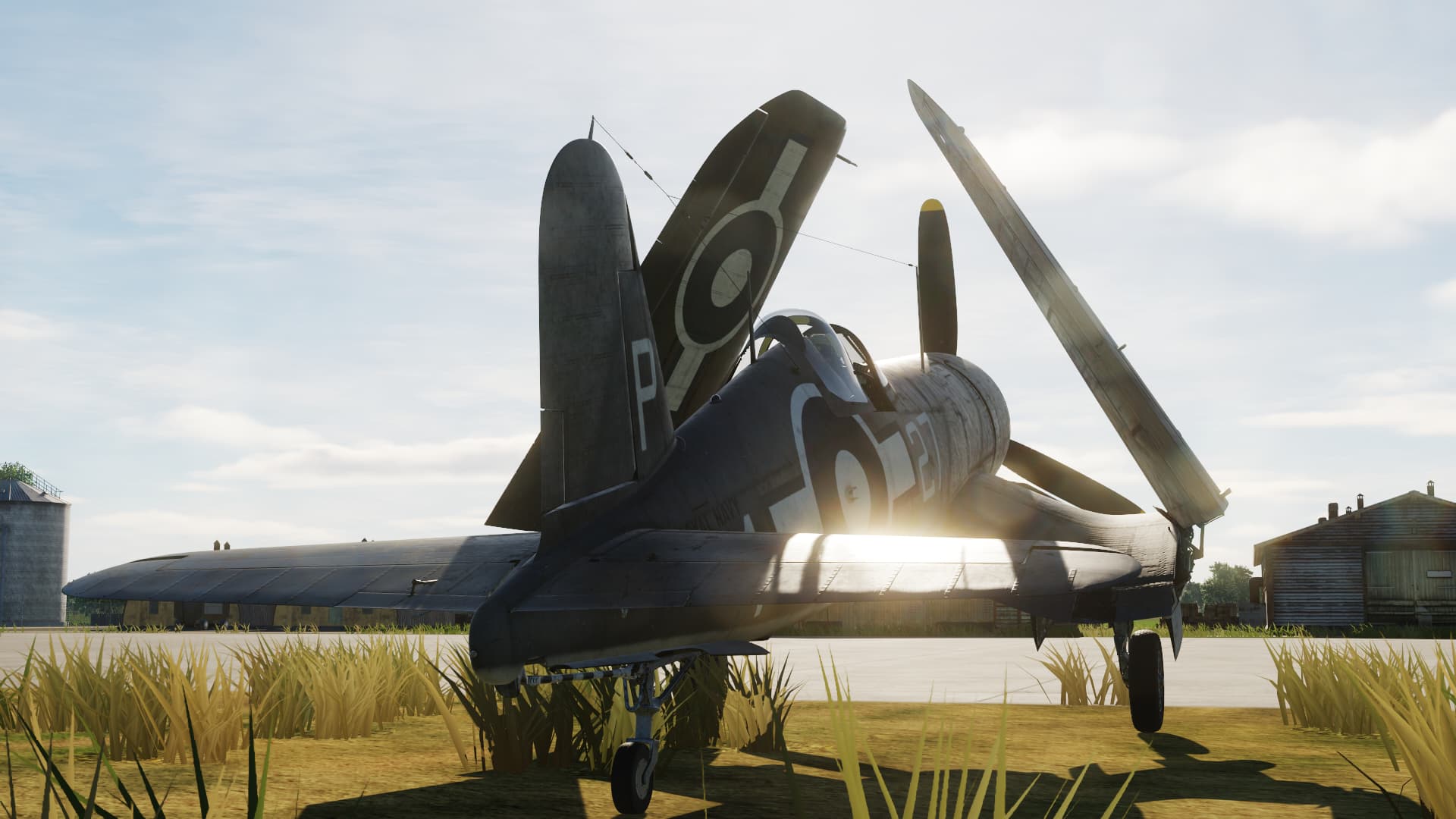
As fun as it is to ignite Zeros in the Pacific, I think pounding the Reich with rockets on the beaches of Normandy would be a fun semi-alt-history operation for FAA Corsairs.
4 Likes
Definitely! Does anyone know what the modeled differences are between the US model and the Mk IV?
1 Like
The Mk IV should have a slightly better roll performance, but the clipped wings are to accommodate the lower ceiling on a British carrier interior.
2 Likes
In Mission buildee you can choose the MkIV or the F4U-1D.
And by dont work, i now realize you meant they cant be bound to a button.
So let me add that none of the lights can be bound.
I hit about 300kn but 400 is not happening on level flight.
2 Likes
The Corsair made its best speed, IIRC, at about angels 20. So I wouldn’t be surprised if we never see 400 on the dial due to how IAS drops off with altitude (absolute pressure).
If I’m remembering right, 300kts indicated at 20,000ft is almost 450kts in a standard atmosphere… there’s calculators online if you need more accuracy 
Edit: and it’s also in knots rather than the more usual (for WWII fighters) MPH, so that’s another thing that will make it seem like you’re slower than you really are!
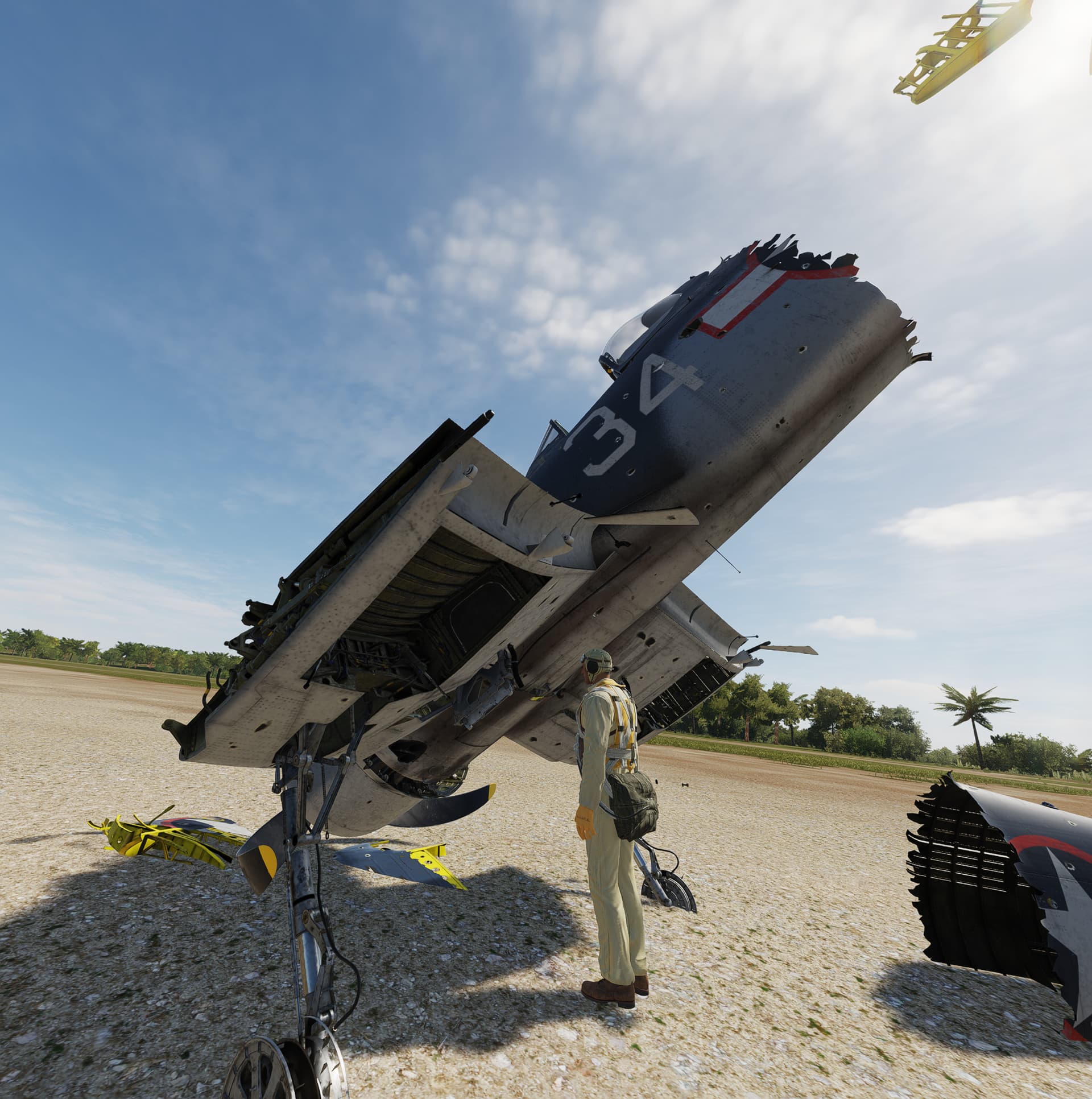
My first flight went about as well as expected considering I hadn’t read any manuals or watched any tutorials. Startup, taxi, takeoff, flying around, and landing was all fairly easy. Lead myself and a buddy into an overhead break, he couldn’t see diddly out the front on the landing rollout. The ground handling is so weird with it stopping any time you try to turn, so I turned to look down the runway just to see a giant prop in my face as I got T-boned 
I think the wheels have some stickiness to them when taxing and landing. I noticed when I tried a 2-pointer, my port main touched first and, upon doing so, the starboard main snapped to the ground just like the refueling drogue snaps to probes when they get within x-feet of the hit box. Takeoff roll seems somewhat tame, but not as tame as the Jug or Pony. I’d rank it somewhere between the Spitfire and Mustang in terms of takeoff roll dificulty.
After takeoff, though, you have to jump on that rudder trim or the torque will frak you up.
Roll seems to lack the inertia I’m used to in the other analog aircraft I fly. It rolls a lot like the M2000C: Move stick, stop stick, wings do exactly as the stick says.
Pitch is sensitive, but nothing egregious compared to the other warbirds.
Rudders are a tad sensitive for my tastes, even with a +30 curve. I’m sure a lot of that is due to my hardware not having stiffness from aerodynamic forces, but doing combat maneuvers it’s hard to keep the nose from oscillating after a roll. In normal admin flight it’s easy to stay cordinated. I love having a slip indicator built into the gun sight.
Taxiing is a bit of a pain because you need to gun the throttle up to 2500rpm to turn more than 20 degrees.
Other than the lacking sound design and weird ground handling, my only other complaint is the horrid instrument layout.
IIRC that’s 400 ground speed, as well. So we most certainly won’t see 400 indicated unless in a dive. That holds true for all the other Allied warbirds we have as well.
3 Likes
True Air speed is Ground speed, in zero wind.
Indicated Air speed is just the pressure differential between total air pressure and static pressure. Basically the pressure from the oncoming air. As static air pressure drops with altitude, so will the indication on the air speed indicator. But the actual (True) speed the aircraft travels through the air will increase. Add or subtract wind from that and you get the speed you are traveling over the ground below.
So, as ground speed is dependent on wind, it is never considered a limit.
2 Likes
not really to do with the Corsair, but more to do with the Mariana ww2 map.
think they may have some of the size scale a bit wrong
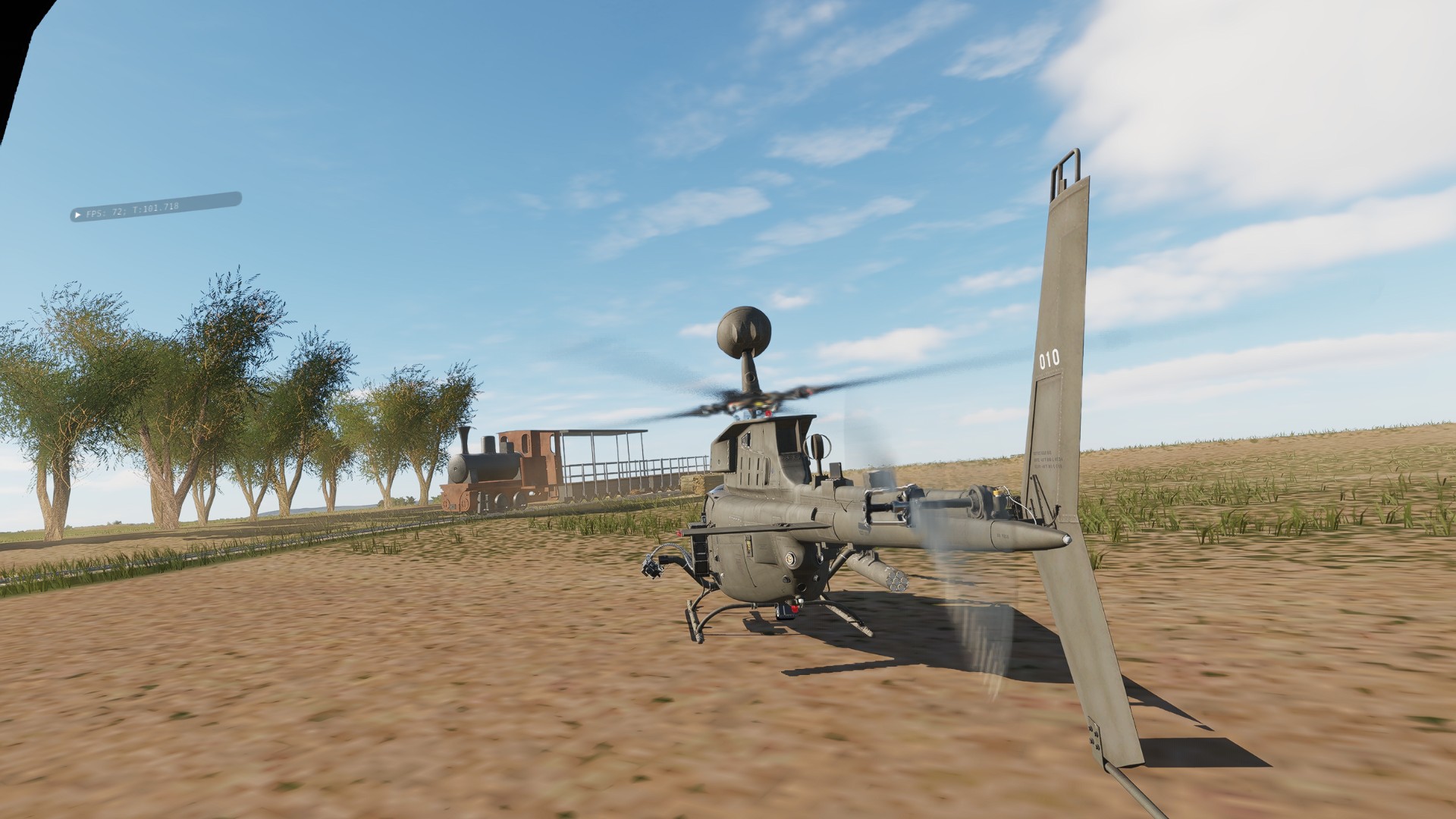
the pic is a bit odd becaause of the fisheye effect from VR … but that train is as tall as my kiowa with the sight mast.
1 Like
Is there a secret to unlocking the tailwheel? It seems that the handle makes virtually no difference with tailwheel behavior. I can manhandle it into a tight turn with forward stick and brakes but that’s such a fugly way to handle such a beautiful old bird. I like it so far but much prefer the P-47.
I decided to take it back to the lab with all the hubub about the F4U being ‘too easy’
So, I took the Spitfire up. I always hear how it’s the most difficult (I absolutely disagree, but it does require more thought during take off and landing rolls, at least) of these old birds to fly.
Frankly, it was easy. I don’t use assists. All I needed to do was do a little dance on the pedals to force it to track straight until the tail wheel comes up. My take offs always tend to be a little early in the Spit, but it’s not at all difficult.
It’s just made me think that, issues with the Corsair’s FM aside, we expect actual challenges in flight. The fact of the matter is that aircraft that are hard to fly do not become legends past the first world war. I also get the idea most of these folks don’t have much stick time outside of video games, but also want the ability to lord over others with feigned authority from their digital experience.
I’m going to say the quiet part out loud: Does any player actually care so much about ground handling that they’re going to skip on an experience? Have we become so anal retentive that anomalies on taxi and take off are going to force us to write entire litanies of outrage? Have we decided that cynicism is automatically profound just by the nature of it being edgy or anti-establishment?
Yeah, the Corsair’s taxi model could be middling. But so could the Spitfire’s. Or the Mustangs. Il-2 BOX definitely has a mediocre ground handling model and I’ve never flown a 172 in any of the MSFS series that feel like a 172 on the ground. The reason is that developers do not priorities ground handling anywhere near as much as they prioritize everything else.
I can’t exactly get rated to fly the Corsair or Spitfire through DCS, so frankly? It’s not a big deal. It’s just a game. Yes, there are more realistic sims than DCS out there, but I doubt the USAF is going to let me hop on by and take one of their sims for a spin whenever I want. We’re not so enlightened as the Swedish who put the Viggen sim in a museum where you can schedule time in it.
I’m sure someone will provide an ACKSHULLY and reference some other sim. Good for them, I hope they have intense, good dogfights, but to be blunt? I don’t care. They’re either sims that don’t offer me what I want or there’s some other issue that just prevents me from enjoying them.
These are consumer grade pieces of software, let’s get over ourselves. We are grown ass men and women playing with toys.

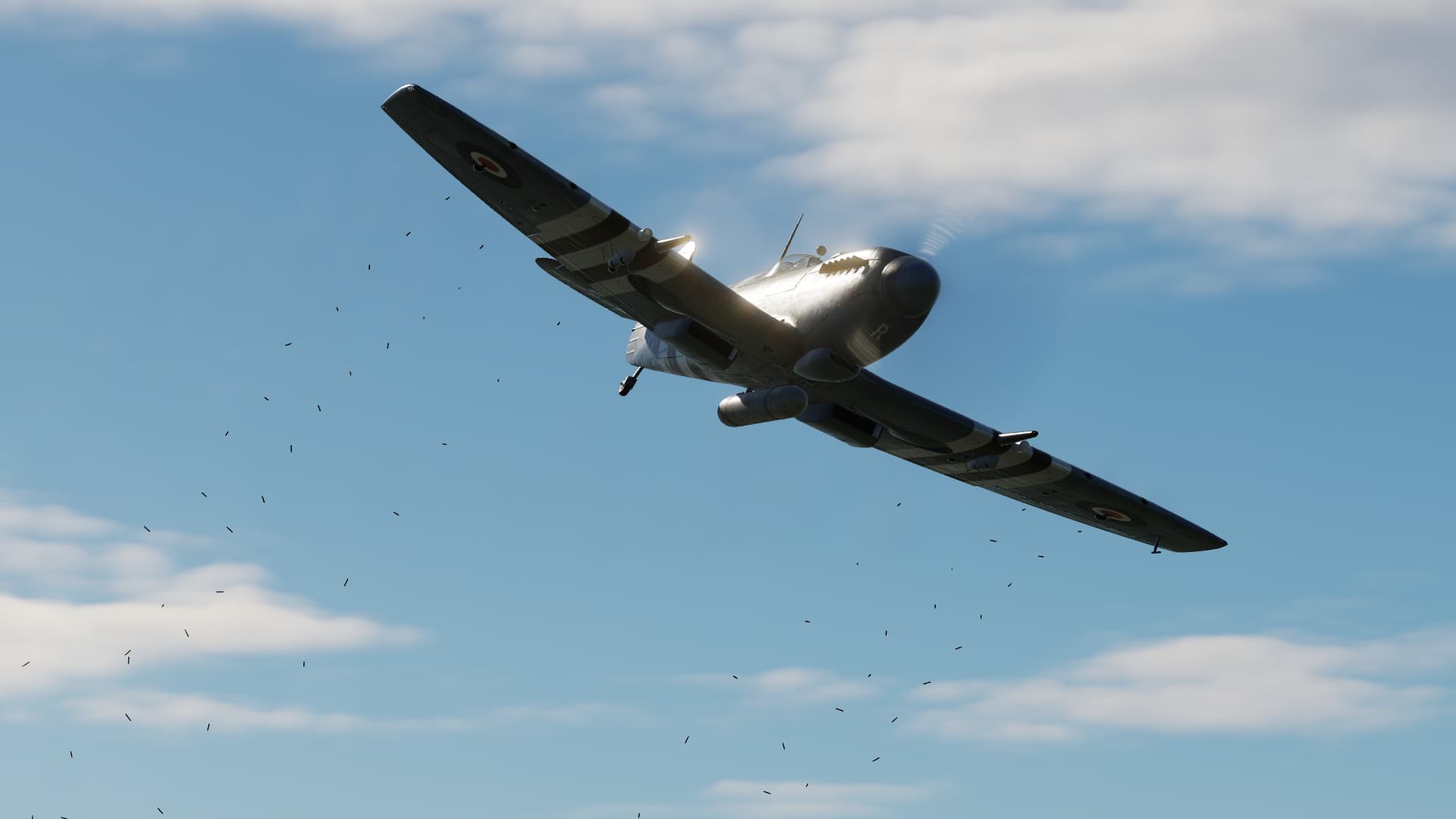
9 Likes
There’s a twitchiness to the handling that I find unsatisfying. It’s not hard. But I don’t think it’s right. I fly what is considered one of the more challenging tailwheel airplanes ever produced in any quantity. It’s certainly harder that these WW2 birds. And so it’s no surprise that there’s a lot of tap dancing needed to keep it between the lights, especially in a breeze. Torque/p-factor/slipstream must be respected. But it’s predictable and, compared to DCS, very much on rails. If you know anything about the Pitts S1 but haven’t actually flown one, you might think you have an idea of the difficulty. If there was a perfect sim out there that presented an exact facsimile of my plane and players brought that idea with them the first time they tried the sim, there would be an uproar. “It’s too predictable, too stable!”; “There’s no way it could be this easy!”; and so on. Flying should be easy. Flying well should be hard.
4 Likes
Ha ha, my dad used to say that about anything that was giving him grief, as in, “that thing”, or “she”, “sure as hell is short coupled today.”
2 Likes
So it’s 400 TAS. My point still stands that it’s not going to be what’s indicated on the cockpit gauge in level flight.
1 Like
Which was what @torc said 
3 Likes
Speak for yourself! I refuse to grow up!
I guess I’m looking for beleivable handling, on ground and in air. So when I botched my first landing in the Corsair because it started skidding all over the place and then nose over, I immediately recognized that this was not normal aircraft behaviour… And then I realized that I had forgot to reverse the toe brake axes which of course meant that I landed with brakes on. Drawing on my vast aeronautical knowledge, I immediately knew that this is not a good way to land any aircraft.
In much the same way I sort of feel when the handling is somewhat not what I expect it to be.
And in such cases, going by @smokinhole’s razor that these aircraft were flown by youngsters with minimal training, I’ll take easier over harder, to control.
But I can’t act as if ground or flight handling doesn’t matter. I do remember the old LOMAC ”stuck to the runway” feeling. While LOMAC was fun and all, the new ground handling sure made me enjoy it more.
It matters to me, but it doesn’t have to be 100% true to the numbers. Believable is good enough…
5 Likes
Yeah, that’s my larger point. We don’t need to be nitpicking ground handling, so long as it’s believable. I’d REALLY wish we’d get ED to look at how jets handle operations on grass. The fact that some just get instantly stuck, like it’s Houston soil in July, annoys me.
3 Likes
I tried pushing the Corsair around a bit and to elaborate a bit on believability of handling characteristics. Spinning is just not believable to me… Idling the engine, holding altitude and letting the speed bleed off, I kicked and held full right rudder when stall was imminent and held the stick in my gut.
The pitch oscillations that you encounter a few moments into the spin doesn’t convince me. The darned thing nearly tumbled over around the lateral axis.
Ok, we’re not supposed to spin, you say - and that’s true. But I feel it is a good way to check if the flight handling characteristics are good enough.
Anyone else tried to spin the Corsair and wish to add to the discussion?
3 Likes
even Bf109 was flown by youngsters with min training and it deasnt make her easy to takeoff and land .
spare-parts distribution ( planes and pilots similarly ) was regular thing during the WWII trainings according to personal accounts .
3 Likes