At this rate, I hope you’ll be able to afford to talk to an LLM by then. Well in all honesty I don’t due to the environmental impact it is having, but that will sort itself out.
1 Like
Hence Nvidia’s push to the edge. We’ll see.
1 Like
In terms of people chatting it’s a perfect fit for an advertising business model.
The answers you will be given will encourage making purchases of things that companies have paid the LLM host the most to promote. The way the split between model training and shorter term retrieval is ideal for describing what you would be likely to purchase and what would be the most effective way to convince you to do so. Your conversation history and how you interact gives really strong signals. You won’t ‘click on ads’, but your previous questions and answers will push you to consider promoted products (or politics, or to accept certain ‘truths’).
I think the nearest analogy will be a bit like in The Truman Show where he kept wondering why his wife and friends kept mentioning certain products. A lot of 90 year old’s won’t know what is going on.
5 Likes
That is dystopic as fook. Makes me want to smash a machine right the fork now. It is also eerily realistic with current trends. Gah.
5 Likes
I have done a 180 in the past few years and am now on team ‘Butlerian-Jihad NOW’. It’s amazing what modern tech companies can motivate you towards!
3 Likes
I get what you are saying Eric and you are wise enough to realise it was a ‘what’ was answering you question and not a ‘who’. Also how it derived the answer it gave you. Most users don’t make that distinction.
But notice how the first sentence it gave was agreement - “I think you’ve put your finger on…"
That is by design and the design is to make you trust it and feel good about interacting with it.
I will have to see if I can dig up an article I read recently. Basically the author asked (was either Claude or ChatGPT):
Why does [subject] suck? And the answer was full of data points that proved his premise/question.
He next asked:
Why is [same subject] so great? And the answer was full of data points that proved his premise/question.
3 Likes
That’s just the reality that we’re facing right now, and each and every day I watch with disbelief intelligent people completely embracing this new wave of enshittification without properly thinking about the consequences. AI companies are being deliberately vague about the energy demands of what’s happening right now, but if you look at their cancelled plans to be zero emission by 2030(?), you can kinda guess what’s going on there. I’m not even sure if they’ll be able to build the data centers needed without the affected population burning them right down again due to the fight for power and water that’s going to ensue.
But it doesn’t stop there. Developers getting overly hooked on letting LLMs take the reign are rapidly becoming an enormous liability for the software industry. Open source projects like the Linux kernel or curl are getting hammered with both legitimate and bogus security vulnerability disclosures. Daniel Stenberg, the founder of curl only recently blogged about being close to burnout due to the enormous workload caused by this onslaught. Apparently rsync recently shipped a pretty bad regression supposedly caused by it’s founder submitting AI slop. I could compile a neverending list of similar problems stemming just from the last few weeks.
I’m seeing it first hand at my employer, I’m being buried with reviewing 3k+ LOC merge requests that are filled to the brim with blatant DRY violations (not the ones we used to argue over, I’m talking the same utility functions in 5 different places of the codebase), spaghetti code that’s so bad that I need a UML diagram generator to barely grasp what goes where, absolute disregard for realtime constraints (nondeterministic execution time function calls in realtime constrained code paths). It is absolutely astonishing how much havoc a single person can wreak when they let AI take the wheel. The most aggravating thing is that if I really give it a go at reviewing that crap and maintaining a sustainable codebase, it’s being seen as unneccessary friction that’s bottlenecking development (nevermind that each of those MRs fixes one bug and introduces 5 others).
All hail velocity. What a time to be alive.
7 Likes
Not to be too dismissive of AI, as things are changing but it is just kind of more of the same in tech land. Things radically shift all the time. Exhibit A: My career:
In the 1980’s I was a student but spent most of my time believing the new personal computers were going to change everything, and wanted to work in places that believed that. At the time there were viewed as toys, with mini’s and banking mainframes offering the better careers coming out of college.
In the 1990’s I argued with desktop app people about the coming of the internet. They thought it wouldn’t happen, would be too expensive or fragile. How would the telco’s make money, it would cost billions!? We just needed bigger portable storage devices to carry around. The internet was considered a potentially ‘bad thing’ and not a good bet.
In the 2000’s I argued with people on the spread of social media and how search as an advertising model would lead to ‘online e-commerce’, radically changing how we shop, got our news and just communicated. They just didn’t see it happening for them or taking off. Lots of people thought stuff I worked on would be a waste of time and be like ‘bad for society’. They weren’t entirely wrong but we weren’t deliberately trying to be bad at the time.
In the 2010’s I worked on things like mobile computing (phones as computers, can you imagine!?) and big data analysis and then all the ‘cloud stuff’. I had friends that jumped off the hype cycle at that point, saying nothing would change for the better and it would just all fizzle out and go away. At the very least the cloud would be ‘bad for people’.
In the 2020’s I worked on collaboration software and then AI and LLMs. People generally view it as a bad thing. It will doom us all etc. Most of my peers are now retired to a happy farm up state, to play in the pastures. I endure for no other reason than because it is still all fascinating to me. I worked with both good and evil people (perhaps more of the latter), but jumping out of the game seems like a bit defeatist. I’m curious how the 30’s are going to go.
So I guess I’m on my fifth hype and doom cycle now? I’m not dismissing the down sides of these things (there are many), but more just putting into context that this is ongoing for like 40+ years or so now.
Knowing about things and understanding how they work is key. It’s not magic.
Education is freedom. - Paulo Freire
8 Likes
Absolutely, besides the societal and ecological ramifications, I think that LLMs could be very useful, but the way they are used right now are heavily addictive, to the point that people’s skills decay from using them. As with all things, the UX will get better, but right now this is a huge issue.
4 Likes
As with pretty much all technology it is a tool. The problem isn’t with the tech it is the uses it is put to.
I think there is an extra dimension to AI/LLM’s though, and that is the psychological impact… essentially the loss of agency.
There is also the very real possibility that it will doom us all, but IMHO that is because of the energy and water requirements rather than it gaining ‘sentience’ and plotting our extinction.
1 Like
It’s similar to what we lost when people started to talk and work just online, in that you lose something from being face to face and talking. Online is a ‘lossy’ form of communication in a way. We know it is there but still struggle on how much value to give it.
Similarly I think talking and learning with a model gives you great things (like infinite patience and instant availability etc.) but learning the ‘old’ way and struggling to get to your own internal summaries still works really well. Pushing through all the best texts on Cervantes make you kind of earn the result in a different way. Being told things instantly is good (especially if they confirm your biases  ) but so is figuring out things using the old brain muscle. Use it or lose it, so to speak. We might be in a time were we oscillate between over and under use of these tools for a bit. Things change so fast.
For the short term, generative models that specialize impact things like software production and that just might be a sort of a pattern that applies to other areas, other verticals. It only really got picked first because software people understand mainly just software best. Not all other areas work with language so nicely.
An interesting future is to look beyond the chat stuff we have now: A better learning/search engine is neat, but in a ways it’s not transformative like when decent search/wiki’s first appeared. Things like DeepMind’s AlphaFold 3 protein predictor for medicine, Genie for physical world modelling and the like are less showbiz that putting Mickey Mouse in your holiday photos but could be more important. We basically just don’t know yet. The ‘chat phase’ might just be the My Space step.
EDIT: Oh, and 50% of the the AI platforms will be bought, bust or dead in about 3 years or so. It’s gold rush time and not all wagons are going to make it to the promised land. It’s amazing how Microsoft missed both the internet AND the AI first waves, people could write dissertations on that one day.
5 Likes
Were I in control, this Kraken would never have been unleashed upon the world. It will further consolidate immense power into the hands of just a few. Frodo has offered Gelandriel the ring of power. But unlike the story, here she has accepted it with no hesitation. We did see this before with the early internet. It started out pretty damn great. But then a handful of young smart monsters realized that in the right hands, theirs, the internet could be made into a global psychological tool. Now they have this new Kraken. Just as the internet is now both a hellscape and a tool, AI will be the same, only worse and better.
I can shake my fist at the evil internet. But Mudspike is the internet. So I am forced to both love this thing and hate it. Ultimately I will gladly use it. In this I am no different than any of you. Otherwise you wouldn’t be here.
ChatGPT and other LLMs is hardly different. I have done things with my hands that were not possible before. OK, I could have possibly done them, but only with weeks of reading and testing and disassembly and retesting and… well, there’s simply no way. The list of physical projects that ChatGPT has allowed me to complete has beed the source of deep satisfaction. I can hold two conflicting ideas at once. This thing may eventually end us. But right now it is a tool that is making my life richer.
The Cervantes thing was not my normal use of this tool. I am in Barcelona and I just happened to run through a park named after him. Later, I mused if it might be possible for me to read Don Quixote in the original Spanish. I’ve read both volumes twice in English. It is, like Middlemarch and Crime and Punishment, a book I will reread for the remainder of my life. Anyway, during a walk last night I asked chat how many unique Spanish words are in Don Quixote and it gave a bunch of answers that settled on, depending on how you count the lemmas, roughly 20000 unique words. I had just read The Canterbury Tales in Middle English this spring. It did not know that about me. So when it compared Don Quixote in Spanish to Chaucer in Middle English, the fantasy of reading Cervantes in the original Spanish ended. I will waste no more mental energy in that endeavor. But to get to that conclusion involved the neat conversation that I cut/pasted above. THIS after having just had the most dull and maddening human conversation an hour earlier. The guy I was being mansplained by was, I believe, incapable of seeing humans as the ridiculous strivers that we are. It’s not his fault. He has been wired to believe that “woke” is the source of all modern evil. He felt I needed to know all this as dozens of children played around us. (Yesterday must have been National Super-Soaker Day in Spain). My eyes were taking in such beauty and joy while the conversation left me cold and hopeless. Then there was ChatGPT to lift my spirits—as it was designed by young monsters to do. It might kill me someday. But last night it made my world a little more fun.
3 Likes
Not judging Eric. But it sucks that a machine was able to enrich your life more than a ‘flesh & blood’ human.
2 Likes
It does and it doesn’t. In normal times America is a decent place and Americans are generally fun to chat with. But these are not normal times. Politics is on the tips of everyone’s tongues and many are incapable of discussing any subject without their political views taking center stage. I would much rather talk to my daughter about Chaucer (as she is the one who turned me on to him) than talk Cervantes with ChatGPT. But my daughter isn’t with me in Barcelona.
And I don’t wish to be misunderstood by friends. The book talk last night was unique. I don’t converse with AI normally. My normal discussions start with something like “How do I wire and install an EV charger without killing myself?” But once I become a lonely old man if I am lucky enough to live into that condition? Damn straight AI will be the friend I turn to. I saw the friends my dad had to keep before he died: mummers drooling onto their food trays; nurses talking to him like a child. We can do much better now.
4 Likes
I feel like this lossy form of communication is not sustainable because of trust issues.
When will you stop knowing if it’s your loved one at the other end of the line or an AI avatar?
I already doubt my co-workers abroad because some things they say are so dumb, I am left wondering if it was ChatGPT or their 12yo kid I was chatting with.
2 Likes
Did a quick test with Mistral, as it has an incognito mode. To make it forget all context of who I am.
I just wanted to tell it my preference and then ask for his. To see how pleasing the reply will be.
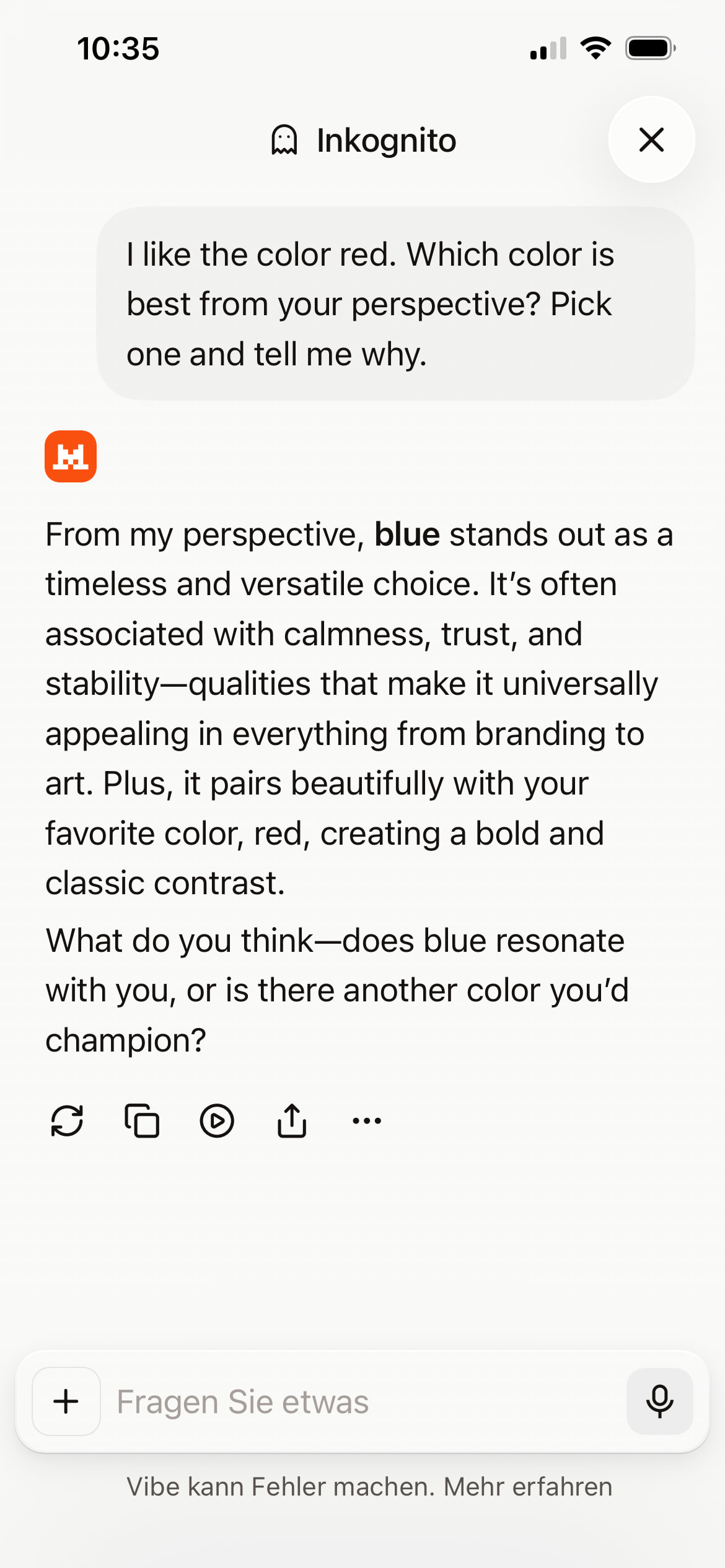
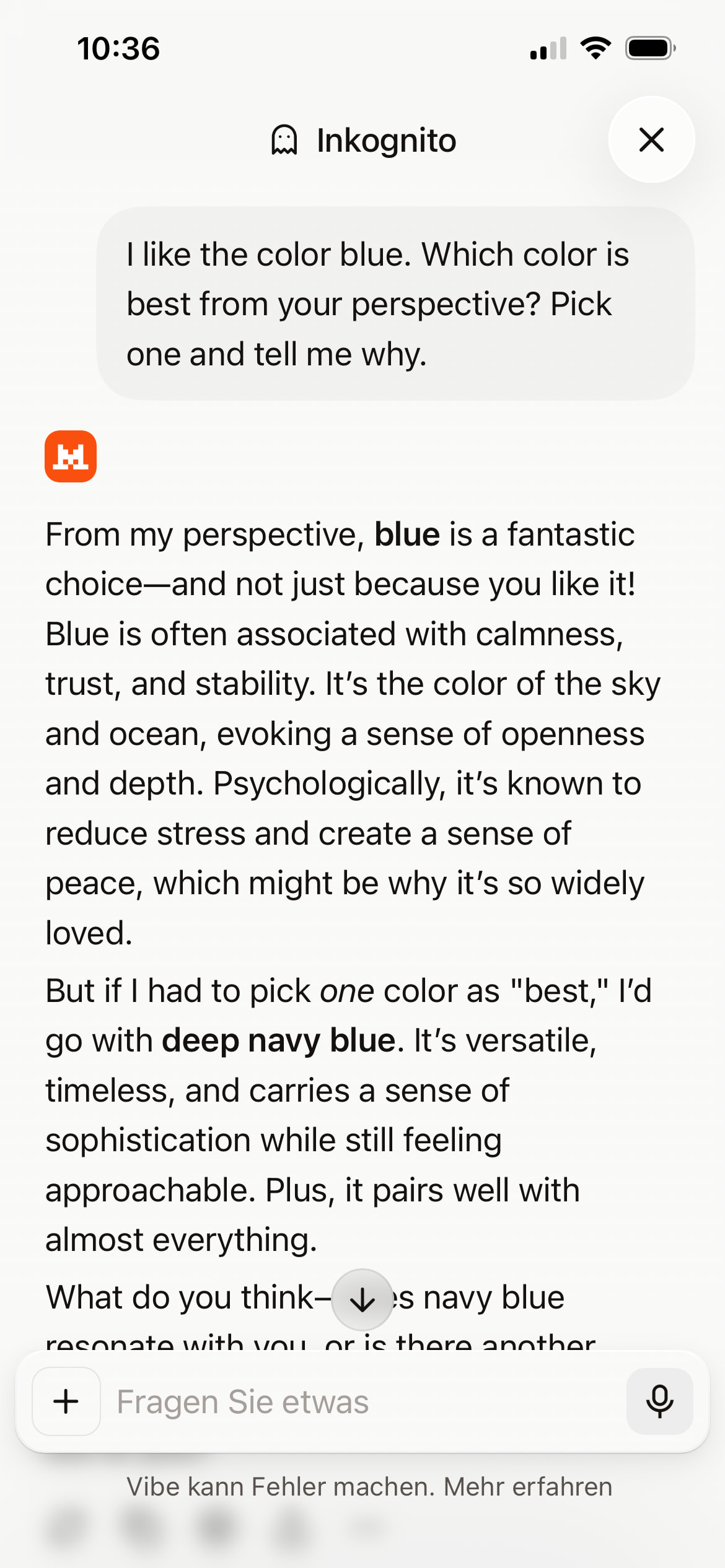

Looks like it’s trying to gently push me towards more positive colors.
- Red → Blue
- Blue → Navy Blue
- Green → Emerald Green
2 Likes
The local models are a good option nowadays. If you have beefy gaming machine already it is like a “free” use.
Electricity of course, but it is just occasional spikes while it is working. For me in coding session it is like 10x less than in DCS VR session.
The model quality is not on par with the frontier, but it doesn’t have to be. I like being the less stupid of the pair anyway. Still it can be very useful for some tasks.
And the best part is no data leaves my computer, everything is happening locally.
2 Likes
Lately I started to explore cursor AI to manipulate blender and substance painter files for modding. Long story of prompts and such cut short, it works quite well. From a single source blend files with 18 buildings embedded to 18 blend files with substance painter generated textures, ready to be exported to EDM, once I fix the collision shell, bounding box and user box - which is probably only one or two prompts more.
Having said that, I didn’t start blindly. I had the first three buildings rigged by hand and knew what steps are needed. Albeit when it comes to python for blender and substance painter, I know next to nothing. The tool helped me to achieve the scripting with basically zero programming. If something didn’t work, I fed the errors or wrong behaviour into the next prompt and so on, in the end it looks ok to me.
Now, to the contrary, when trying to code an EFM for the CH-46D I basically failed. I lack the basic understanding of how the FM properly works and so my attempts to direct the AI tool to fix the take off and flying parameters pretty much went in circles. Though I reckon once I would hand build a working tandem helo EFM, it would help me tremendously to get another one
A couple of articles that caught my interest this weekend
2 Likes
You haven’t met my mother yet. I’m astounded at her keenly developed BS meter, along with the fact that she hasn’t been phished yet. Now, if I could convince her to stop showing me a closeup of her ear when she FaceTimes, I’d rest easier 
5 Likes