It is always the first thing I try with each update…  Still not working.
1 Like
T-10 days, I’m sure they’ll get it squared away. Have you tried dropping bombs and watching the wings? Curious if they jump around like I see in all the cruise videos. Turbulence seems to get them rattling as well.

I’m sorry for you exasperation…but that chart didn’t answer the question…
1 Like
I think the answer is in the Tactical Manual Pocket guide…browsing right now…
It doesn’t appear to be…
As far as I can tell there is no limit to ordinance if it doesn’t exceed the gross takeoff weight and doesn’t exceed a maximum asymmetrical balance of 28,000 foot pounds.
1 Like
Yeah…that’s what I’m trying to figure out…I’m sure there exists a configuration of possible weapons that would set the absolute practical weight limit of ordnance. I was just wondering if there was a wing or structural limitation as well. For instance, some airplanes have a max zero fuel weight (ZFW) that is a structural number. So sacrificing fuel for more payload only works until you reach that ZFW limitation. I was just curious if the Hornet had such a number.
I keep seeing the number 13,700 lbs. come up frequently enough that it might be right. I mean…Air Force Magazine printed it… LOL…
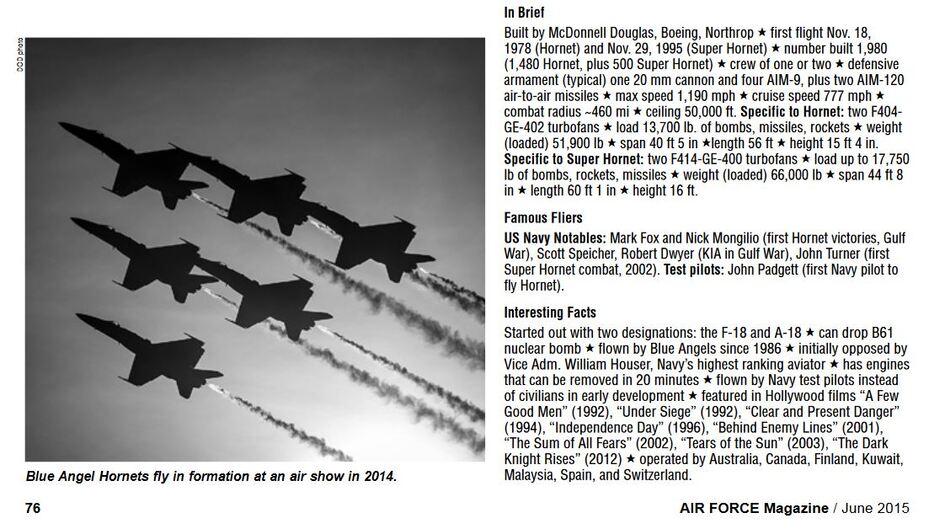
I’ve looked through the 400 occurrences of the word weight in the manual. I can’t find any reference to Max ordinance or 13,700 pounds.
1 Like
Hey…as a pilot, the only sentence you need to be concerned with is this one:
“Weight and Balance clearance is the responsibility of the maintenance department.”

4 Likes
Hey Beach, what you are looking for would be in Volume 2 of the F-18’s NATOPS Tactical Manual. As with most of these manuals, it isn’t that it is actually classified, it is just that nobody has requested a review and posted it to the internet. It is possible ED got a copy as part of their licensing deal but I have no idea. I think we are just out of luck.
You will see an example of what I mean if you check AV-8B volume 2, starting at page 5-11:
There are usually 40-50 combinations that are flight tested and approved as authorized configurations. There really isn’t any math involved at the operational level. You just follow the tables and notes. Some of the configurations go right up to the structural limit although that isn’t always the determining factor.
Flying qualities, flutter, clean separation on release, and physical separation between stores drive this too.
Even this might not be exactly what you are looking for but it is the definitive list everybody works off of. In my weapons loader days, it was the first place I would check if a weird configuration request came down from ops.
3 Likes
We need a mudspike FOIA request
4 Likes
Yeah, that kind of thing would be in other manuals dealing more specifically with ordnance.
It’ll specify prohibited configurations, etc. I’m not sure how you’d get much heavier outside of swapping a couple pylons worth of MK-83s for fuel tanks.
Real world we’ve got a program that we can change the configurations on and after a several painful minutes of wanting to bash the computer, it’ll tell you if the configuration is valid or not.
I see @bunyap2w1 beat me to the punch!
3 Likes
Thanks for that. I’m mostly just being pedantic because invariably I will write (for the magazine) 13,700 lbs. seeing how that seems to be the generally accepted figure, but someone will have loaded lead lined fuel tanks on it once upon a time and prove to me that my number is wrong. 
And as you and @near_blind have pointed out, the military may bury things that aren’t operationally necessary to know and they don’t always necessarily adhere to the limitations that civil aviation have as part of their published limitations.
Someone more dedicated than me could probably go through the inventory of weapons available for the -C and find out which is the heaviest weapon you could hang from each station and in what multiples, and come up with a definitive max possible ordnance load weight. I’m assuming perhaps the GBU-24 Paveway III is the heaviest piece of ordnance the -C Hornet can carry at 2,315 lbs. (?)
1 Like
Yeah, the best I could do was this:
Gun = 445 lbs.
Center station - 1 Mk84 = 1,971 lbs.
vs.
Center station - 1 330G tank = 2,535 lbs. (tank + fuel combined)
Station 3/7 - BRU-33 with two Mk-83s = 2,145 lbs.
vs.
Station 3/7 - 1 330G tank = 2,535 lbs. (tank + fuel combined)
Stations 2/8 - BRU-33 with two Mk-83s = 2,145 lbs.
vs.
Stations 2/8 - 1 Mk-84 = 1,971 lbs.
So it looks like the heaviest possible load in Early Access anyway is:
3 x FUEL = 2,535 lbs. x 3 = 7,605 lbs.
2 x BRU-33 x 2 Mk-83s = 2,145 lbs. x 2 = 4,290 lbs.
2 x AIM-7M = 507 lbs. x 2 = 1014 lbs.
2 x AIM-9M = 192 lbs. x 2 = 384 lbs.
Gun = 445 lbs.
That equals 13,738 lbs (so my 13,700 number is already dead!..might have to go with “nearly 14,000 lbs.”)…and a total weight of 39,379 lbs.
Adding 100% internal fuel takes the weight to 50,182 lbs.
1 Like
I can’t find anything heavier than the GBU-24. All the Harpoons are <2,000 lbs. The Walleye might be, depending on the type we get, but idk for sure.
1 Like
Oh man…the end of this video made me sad…RIP B-29…
I have not yet found a more satisfying end for Soviet capital ships than the Walleye II ERDL, delivered en masse with ECM support.
2 Likes
Right, dropped on a radar track through a solid cloud cover and TV guided on target with the datalink once the weapon brakes through  Can’t wait to try this!
1 Like