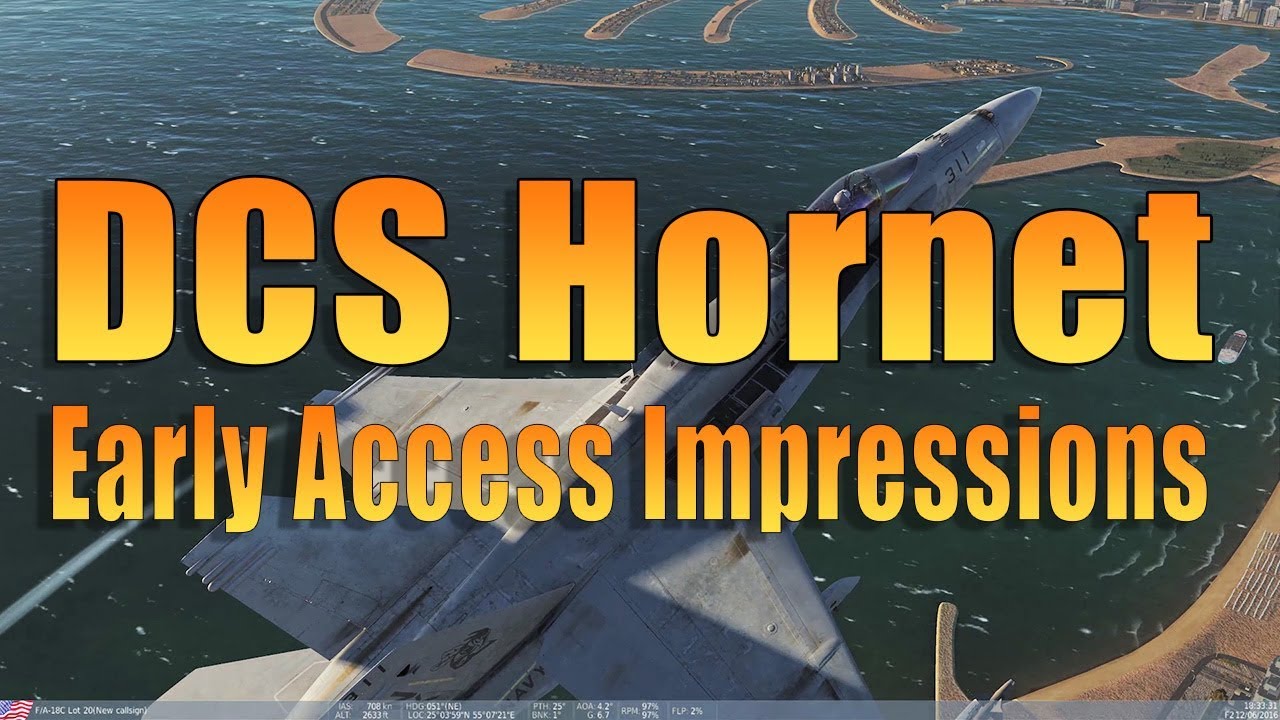
So I spent most of the weekend watching hornet stuff, and have come to the conclusion that this will basically have the functionality of the M2k +carrier ops on release. I’m totally ok with this.
Really looking forward to learning the more advanced systems as they get implemented.
Would somebody mind posting a link to the manual everyone seems to be reading to get themselves prepared to fly this bad boy? I’m guessing Eagle Dynamics will not be posting their version of a manual until much closer to a finished release.
I’d say it’s a bit of a mixed bag. In A/A you lose the SA of TWS for the time being, but the Hornet can carry twice the weapons of the Mirage. Depending on your willingness to fight drag and fuel, you can carry three times the MRMs, or twice the MRMs and three times the SRMs.
On the A/G front you carry the same number of bombs, but can carry a much higher tonnage. The Hornet also offers a more reliable and less capricious means with which to deliver them accurately. imho that’s not a bad trade for buddy lased Paveways.
Like half of that is emergency checklists and procedures.
So there’s almost 900 pages of bureaucratic bravo-sierra and one page that reads “stick forward, houses get bigger, stick aft, houses get smaller”… That figures.
There are about 600 or so pages explaining how the various systems works, how the plane flies, and what all the displays are and mean, and what the procedures are for general operations. There are 200 or so pages that explain what to do when in situations that happen in reality, but are generally impossible in DCS without specifically making them. The rest are intentionally left blank.
If you want to know how to fly the Hornet, it helps to read. If not, you can probably survive without it.
Naw, there’s a lot of butt saving information, like this paragraph…
F/A-18 catapult launch endspeeds are determined by one of two limiting factors, single engine minimum control airspeed and sink-off-bow. At gross weights of 45,000 lbs and above, the minimum launch endspeed ensures that the aircraft will not sink excessively during the catapult flyaway. With normal endspeed (11 to 20 knots above minimum) and deck conditions, 4 to 6 feet of settle can be expected. The pilot perceives the catapult shot to be level, as the rotation of the aircraft keeps the pilot’s eye approximately level, even though the aircraft center-of-gravity sinks. With zero excess endspeed, up to 20 feet of settle can be expected. For heavy weight shots which are planned with 10 knots or less excess endspeed, trim settings are increased 3° to help minimize the settle that will occur. This higher trim setting comes at the cost of reducing the margin of controllability should an engine fail. Therefore, the higher trim settings should only be used when advised by the ship that the shot will definitely have 10 knots or less excess endspeed. The higher trim settings bias the compromise between aircraft controllability and minimizing settle to favor minimizing settle, because in the case of a planned reduced endspeed shot, excessive settle is definitely going to occur, while the chance of an engine failure is no different than any other shot.
Nope…I think that’s it. Wednesdays were my replacement pages and pen&ink change days. Then, as classified material custodian, came the destruction of the old pages, and all the witnessed and signed record of destruction (kept for two years) that went along with it. I think few were happier when all that stuff went on line.
OK, here’s the deal on NATOPS pubs…they are more of a reference than lite reading material. You really don’t have to read the whole thing to fly a sim because there’s a bunch of stuff not modeled.
You should really, really should to read and memorize the BOLD FACE sections. Naval Aviators are often required to recite a BOLD FACE paragraph from memory at the flight brief. Mess up reciting the BOLD FACE and guess who isn’t going flying today.
Sure, read the interesting parts like the paragraph that @chipwich found…however, each cat shot is different, even among the same type of aircraft.
As the jet is taxiing to the cat, a flight deck sailor (green shirt) approaches with what is called a “weight board” - essentially a box that shows numbers that are supposed to reflect the TOW of the jet. If correct, the pilot give a thumbs up. If not correct the pilot uses standard hand signals to raise or lower the number to the correct TOW until he can give the thumbs up.
The weight board guy then shows the number to the sailor that is setting the catapult, who, ironically enough, is sitting with another NATOPS manual on his lap, open to the correct page where there is a table for the aircraft type and its weight (there is probably some wind variable in the table too). He/she then sets the catapult to fire with the correct force to get the jet off the deck at velocity at or above its normal endspped (as described in the section @chipwich found) …its a Goldilocks thing…not too much; certainly not too little; must be just right. (If you’re interested, it is the speed which the steam valves open that determines the force of the cat stroke). BTW, the guys/gals that do all this are usually aged 18 to early 20’s.
In the sim, unless they have worked a way to take wind and weight into account for the cat shot…I’m betting that the whole simulated cat shot process just takes you from 0 to about 150 knots relative to the boat. That plus any head wind and you should be able to fly away. Once airborne, the weight factors “kick in”…at least that’s the way I would program it.