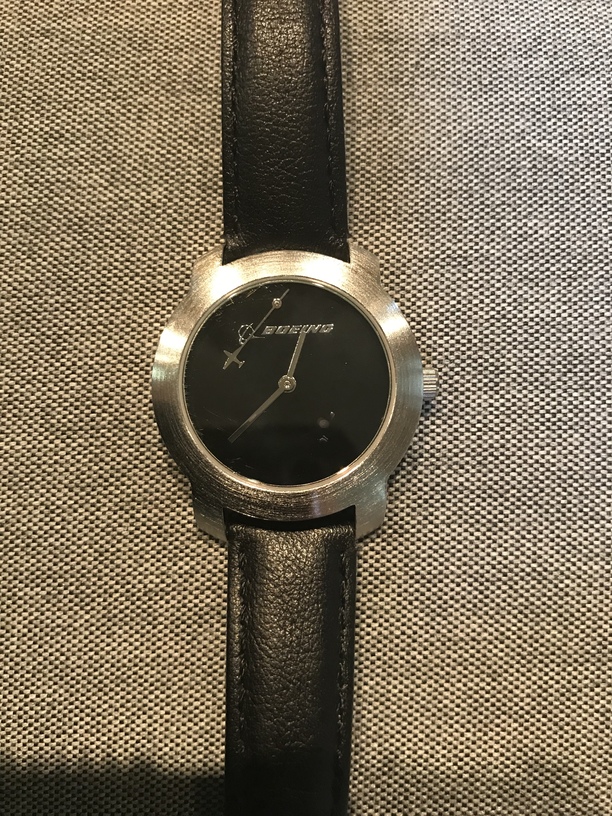
I am not making this up. My daughter realized that her new watch was broken this morning. A sign?
7 Likes
Omnious signs there! Broken like a clock…
1 Like
No doubt Boeing would take take great pains to point out that the watch is not at fault in telling the wrong time, that it conforms to the minimum requirements for certification tjat it be correct at least twice a day, and it was a chain of events that included operator error for not looking at the watch at the correct time of day to ensure its accuracy, and not disregarding the displayed time as is stipulated should be done in the manual when the watch is not functioning correctly 
Too much?
12 Likes
Just perfect!
6 Likes
Ok, not much additional information or in depth analysis here, but the interview with the former NTSB director is interesting.
Relatively balanced report from the BBC:
Nothing new, but still a good article encapsulating all we’ve learned thus far. The one flaw in the piece is its sourcing of Mary Schiavo. Actually, she doesn’t have much to say and what she does say is correct—rare for her. So no harm done. But among people who know, she has zero credibility*. Mary has been famous among airline pilots for a generation as being a CNN shill who will say in two sentences whatever sensational thing that will bring attention to the bit.
*I realize that this sounds sexist coming from a male-dominated profession. It’s not. Mary is just the most prominent (and most consistently outrageous) of former DOT and NTSB paid media personalities, the others are men.
3 Likes
Here’s another BBC report, this time focusing on the at the legal / political manuevering that seems to have taken over.
Graves is a Republican congressman who has been a vocal Boeing defender during the Max debacle. He’s not wrong, just selective. And Boeing is his biggest constituent fwiw. No doubt, they should have disconnected autothrust and retarded the throttles. But there is no guarantee that this would have saved them. They were pointed downhill and accelerating regardless. Reducing the throttles would also have compounded the nose-down moment that already had them staring at a windscreen full of earth and no sky. The crew isn’t blameless. But I understand their actions. And theirs is not the original sin.
1 Like
A pilots perspective, and a couple of bits of current information:

2 Likes
Fantastic article
Check the “Reader’s Picks” in the “Comments” section. Some moron named Eric Anderson stirred the pot much like “Smokin’ Hole” did over here.
But honestly, I gave the article far too much credit. It started beautifully. Langewiesche is a wonderful writer as was his father before him. But he simply did not understand fully what he was writing about here once his journalism led him down a more technical path. He thought he had a hook (inexperienced pilots overwhelmed by technology they didn’t understand while lacking the ‘stick and rudder’ skills to rise to the moment created by a flawed design) If you didn’t know the plane, that clearly does seem to be the story here. But its not. The comments on the other hand are far more on point than is the article. Not mine, necessarily. But others by engineers and software types who clearly saw that Boeing deserved no quarter.
7 Likes
I agree with your comment to the article.
Some others, however…
Everybody’s an expert it seems.
Someone even used his own experience as a passenger on a Q400, that landed in 10mph tailwind, and used this as an example of pilot incompetence…! 
6 Likes
That article seems to miss the point completely unfortunately. There’s inherent problems in the current design of the max that no good stick and rudder skill can overcome.
1 Like
Exactly! Remove MCAS entirely and what remains is a perfectly safe airplane. But one that will require some training to cover the unique handling characteristics of the plane. Remember, as Boeing now acknowledges, MCAS was not put there to make the plane stable. Nor was it there to make stall recoveries easier. It was put there to avoid the extra sim period that is often required on common types that handle differently, eg, 757/767. But I think they are now so married to the system, they are forced to fix it instead of ditching it entirely.
3 Likes
Exactly, MCAS was designed for South West and other airliners to cut on training costs. It’s not a bad idea and honestly would have been great if they had executed it correctly. And at this point you get to the dysfunctional FAA/Boeing relationship that has significantly hurt either reputation!
I can’t feel but think this whole thing could have been avoided unfortunately. This was not one of those “■■■■ we didn’t know about this” type of crashes like the Comet.
3 Likes
This is what happens when everyone is fixated on costs alone. Because people’s lives don’t mean nearly as much as stock price.
2 Likes
I agree. The author’s view seems to be that if the pilots were good pilots they wouldn’t have crashed. That may well be true, but it leaves out the effects of human factors. Even expert pilots make mistakes on a bad day, and well designed systems can minimise the potential for harm from such mistakes. I don’t think anyone would argue that from this perspective the MCAS is not well designed.
I would say that on every single flight I can identify something that I could have done better. There is no perfect flight, even though we strive for it.
5 Likes
And all of us that have done it long enough can identify flights that could have gone far, far worse if not for some stroke of good luck or fortunate corrective action (a break in the accident chain as it were).
I haven’t had a chance to read the Times article yet.
2 Likes